Table of Content
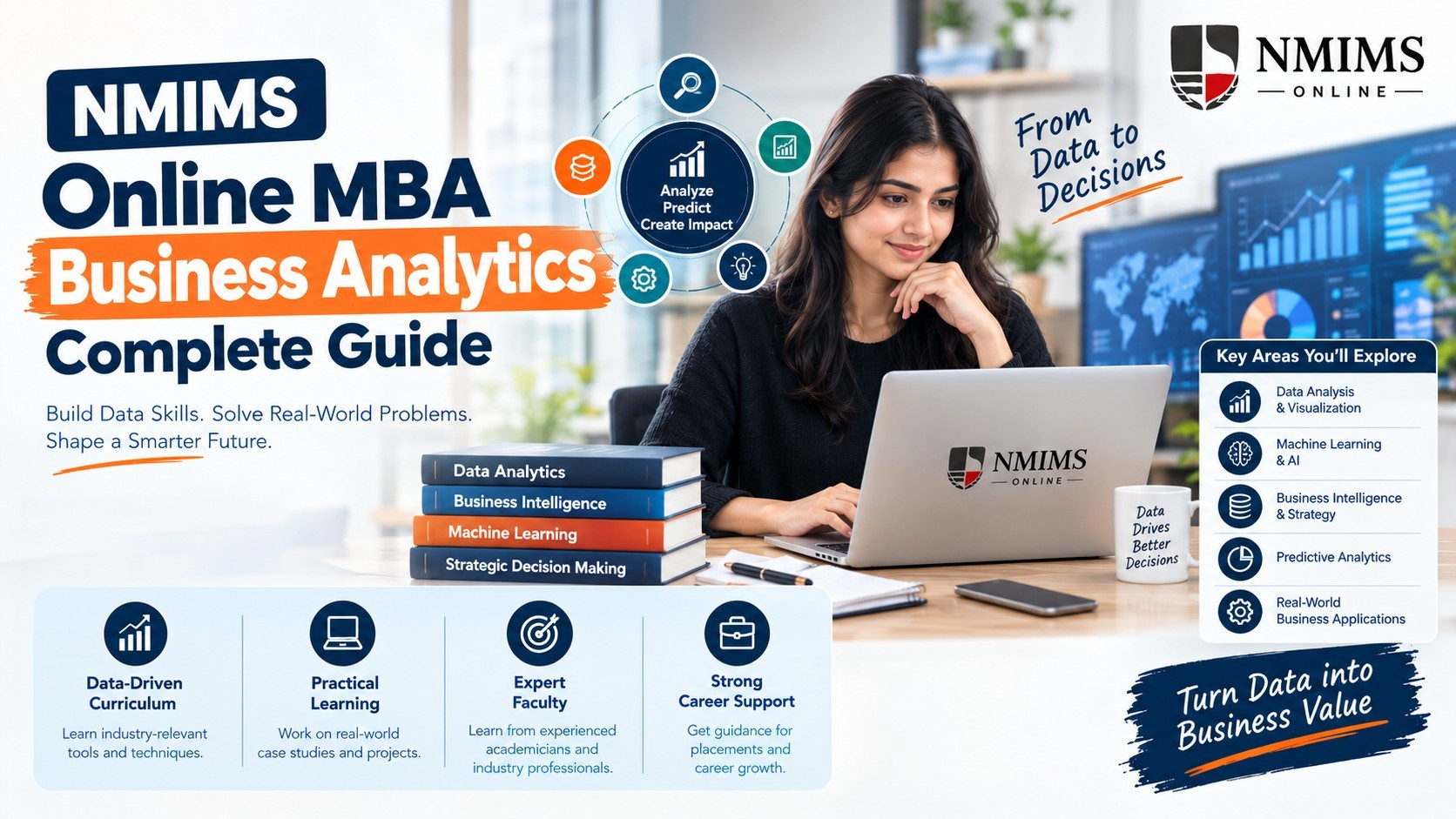
The NMIMS Online MBA in Business Analytics teaches managers to frame business questions, examine data and communicate decisions. Its seven electives are Data Analytics for Business, Machine Learning for Managers, Business Process Modelling and Management, Visual Analytics, Operational and Supply Chain Analytics, Digital Leadership in the Age of Industry 5.0, and Consumer Data Analytics.
The programme is not the same as an MSc in Data Science or a coding bootcamp. It places analytics inside a wider MBA that includes accounting, marketing, strategy, HR, operations, law and finance. That can suit learners who want to become analytics-informed decision-makers or bridge business and technical teams.
NMIMS Online MBA Business Analytics at a Glance
| Feature | Current published information |
|---|---|
| Duration | 2 years |
| Structure | 4 semesters |
| Maximum validity shown | 4 years |
| Evaluation | Internal assessment plus term-end examination |
| Total credits | 102 |
| Analytics electives | 7 |
| Project | 6 credits in the published structure |
| Learning mode | Live and recorded online learning with digital resources |
| Eligibility | Recognised bachelor’s degree with 50%; 45% for SC/ST/OBC/PwD |
| Current full-payment fee | ₹1,96,000, subject to revision |
What Is Business Analytics?
Business Analytics is the process of using data, analytical tools, and statistical techniques to support better business decisions. It helps organizations collect, analyze, and interpret data to identify trends, solve problems, and uncover growth opportunities.
Businesses use analytics to understand customer behavior, improve operational efficiency, reduce costs, and measure performance. It may involve techniques such as data analysis, visualization, predictive modeling, and reporting.
In simple terms, Business Analytics transforms raw business data into meaningful insights that help organizations make informed and strategic decisions.
Start Your Journey
Interested in NMIMS Online MBA Business Analytics?
Talk to our admissions team about the programme, eligibility, fees and learning format.
Semester-Wise Syllabus
Semester 1: Business and Quantitative Basics
- Business Communication
- Financial Accounting
- Marketing Management
- Micro Economics and Macro Economics
- Organisational Behaviour
- Quantitative Methods I
Semester 2: Core Business Analytics Appears
- Business Analytics
- Cost and Management Accounting
- Legal Aspect of Business
- Strategic Management
- Human Resource Management
- Operations Management
Semester 3: Data, Models, Processes and Visuals
- Corporate Finance
- Research Methodology
- Data Analytics for Business
- Machine Learning for Managers
- Business Process Modelling and Management
- Visual Analytics
Semester 4: Applied Domains and Digital Leadership
- Corporate Sustainability
- Indian Ethos and Ethics
- International Business
- Operational and Supply Chain Analytics
- Digital Leadership in the Age of Industry 5.0
- Consumer Data Analytics
- Project
What Each Analytics Elective Covers
Data Analytics for Business
This subject provides the central bridge from raw data to a business conclusion. Learners should focus on question framing, data quality, method selection and interpretation— not only calculation.
Machine Learning for Managers
The title signals management understanding of machine-learning applications. Managers need to ask what a model predicts, how it was evaluated, what data shaped it and what happens when it is wrong. The public list does not prove advanced model-building or programming depth.
Business Process Modelling and Management
Before improving a process with data, the learner must understand the process itself. This subject can help represent activities, decisions and handoffs, then examine where delay, inconsistency or waste occurs.
Visual Analytics
Visual analytics helps people see patterns, variation and exceptions. A strong chart answers a decision question. A crowded dashboard that displays every available measure may create more confusion.
Operational and Supply Chain Analytics
This paper applies analytics to demand, capacity, inventory, sourcing, logistics or service performance. It is more domain-specific than the earlier general analytics subjects.
Digital Leadership in the Age of Industry 5.0
Digital leadership concerns how organisations select, adopt and use technology responsibly. It requires more than buying a tool: process, skills, governance, human impact and business value must align.
Consumer Data Analytics
This area uses customer and behavioural data to understand acquisition, choice, engagement or retention. Privacy, consent, representativeness and interpretation are central because customer data can be sensitive and biased.
Skills and Evidence to Build
| Capability | Subject connection | Portfolio evidence |
|---|---|---|
| Business-question framing | Data Analytics for Business | One-page problem and decision definition |
| Data-quality judgement | Analytics and Research Methodology | Audit of missing, inconsistent or biased data |
| Model interpretation | Machine Learning for Managers | Model review explaining errors and business impact |
| Process insight | Process Modelling | Current-state model and improvement hypothesis |
| Visual communication | Visual Analytics | Dashboard with a clear decision audience |
| Operations application | Supply Chain Analytics | Demand, inventory or service analysis |
| Customer insight | Consumer Data Analytics | Cohort, funnel or retention study using safe data |
| Change leadership | Digital Leadership | Adoption plan with roles, risks and measures |
Who Should Consider This Specialisation?
Business Analysts
The curriculum may broaden an analyst’s understanding of finance, customers, operations and strategy. It can help someone move from documenting requirements toward decision support.
Functional Professionals Who Increasingly Use Data
Marketing, finance, HR and operations professionals often reach a point where reporting is not enough. They need to ask better questions and explain evidence. Business Analytics may support that transition.
Managers Working with Technical Teams
A manager does not need to build every model, but must understand assumptions, trade-offs and risks. The “for managers” orientation can be useful when leading analysts, vendors or digital initiatives.
Career Switchers
The MBA can provide context, but employers may still test SQL, spreadsheets, statistics, dashboards or case-solving. Build a practical portfolio alongside the degree.
Entrepreneurs
Founders can apply analytics to customer acquisition, retention, operations and cash decisions. The risk is measuring everything without defining which decision the metric supports.
Business Analytics Versus Other NMIMS Specialisations
| Specialisation | Main question |
|---|---|
| Business Analytics | How can data improve decisions across business areas? |
| Operations and Data Sciences | How can process, supply, project and quality decisions improve through data? |
| Information Technology Management | How should the organisation manage technology, systems and digital risk? |
| Marketing Management | How should the business understand customers and build demand? |
| Finance Management | How should it evaluate capital, value, risk and financial choices? |
| Business Management | How should cross-functional business trade-offs be managed? |
Eligibility, Fees and Learning Experience
The active page accepts a recognised 10+2+3 bachelor’s degree or AIU-recognised equivalent with at least 50% mark, and 45% for SC, ST, OBC and PwD applicants.
A technical degree and work experience are not mandatory under the current MBA Online criteria.
The fees are ₹1,96,000 for one-time payment, ₹1,05,000 annually or ₹55,000 per semester. NMIMS separately lists a ₹1,200 admission-processing fee, ₹800 examination fee per subject per attempt and ₹800 project fee per attempt.
Official learning features include Student Zone access, live lectures, recorded sessions, e-books, journals, transcripts and support channels. Evaluation is IA + TEE. Flexibility does not remove deadlines.
Is NMIMS Online MBA Business Analytics Worth It?
The NMIMS Online MBA in Business Analytics can be worth considering for working professionals who want to develop analytical and data-driven decision-making skills. The specialization focuses on applying business analytics concepts to areas such as operations, marketing, finance, and strategic management.
It can help learners understand how to interpret business data and use insights to solve organizational challenges. However, its value depends on individual career goals, prior experience, and the effort invested in developing practical analytical skills alongside the MBA program.
Conclusion
NMIMS Online MBA Business Analytics is designed for the point where data meets a business decision. Its subjects cover analysis, machine learning for managers, processes, visual communication, operations, consumers and digital leadership.
It is not a substitute for deep technical training. Verify the active tools and assessment format, add practical data skills, and build projects that show sound judgement—not just attractive dashboards.
Frequently Asked Questions
The seven electives cover business data analytics, machine learning for managers, process modelling, visual analytics, operations and supply analytics, digital leadership and consumer analytics.