Table of Content
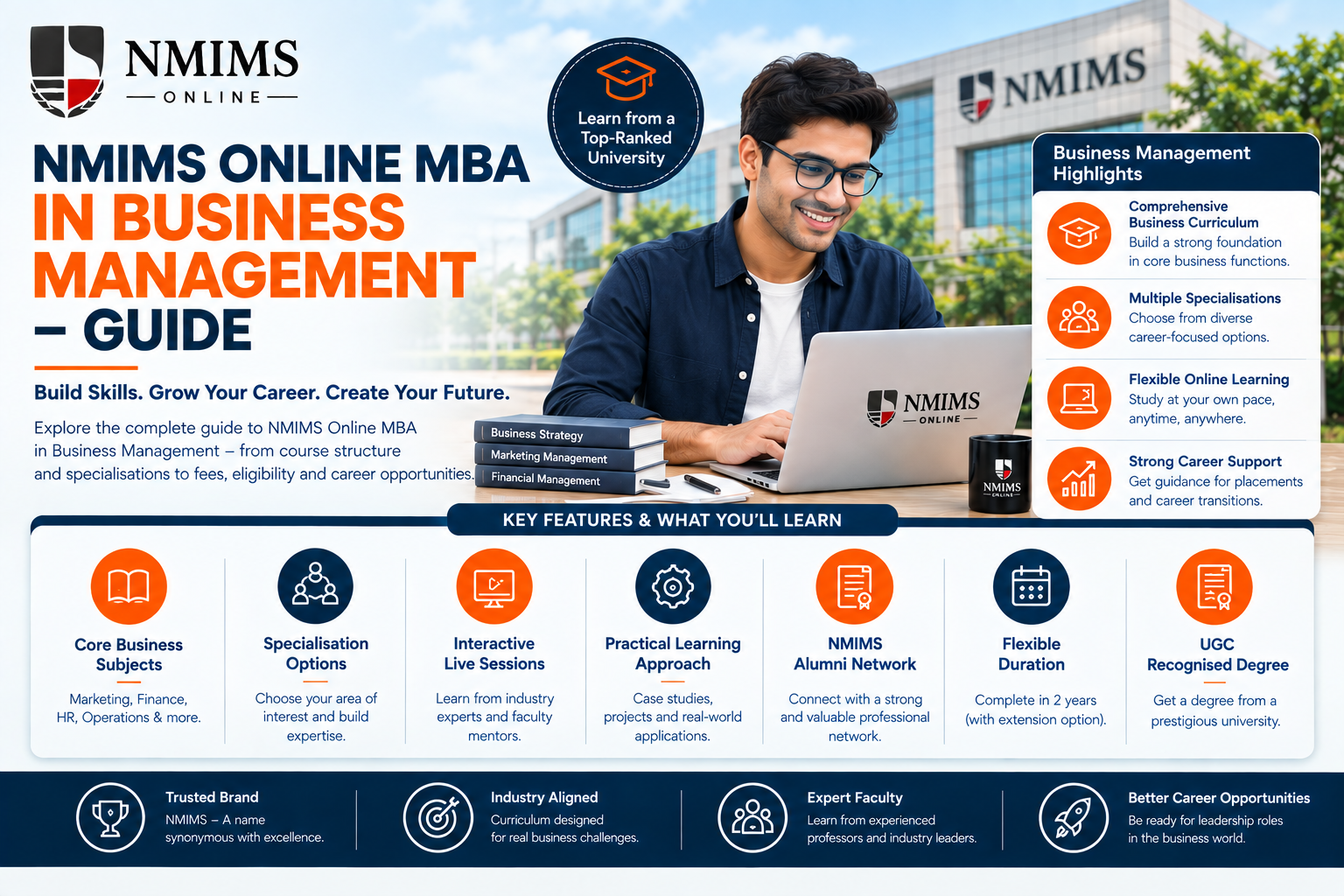
The NMIMS Online MBA in Business Management is a broad, cross-functional specialisation. It combines management foundations with subjects such as information systems, consumer behaviour, organisation design, supply chain management, entrepreneurship, digital marketing and project management. It can suit professionals who need to connect finance, customers, people, technology and operations rather than specialise deeply in only one function.
The programme currently runs for two years across four semesters, with a four-year validity window and evaluation through internal assessment plus term-end examination. This guide explains the subject structure, the skills each area can build, realistic career relevance and the questions to answer before choosing it.
NMIMS Online MBA Business Management at a Glance
| Feature | Current published detail |
|---|---|
| Programme | MBA Online—Business Management |
| Duration | 2 years |
| Structure | 4 semesters |
| Completion validity | 4 years |
| Total programme credits | 102 |
| Evaluation | Internal assessment plus term-end examination |
| Learning | Live and recorded lectures with digital course resources |
| Eligibility | Recognised bachelor’s degree with 50%; 45% for SC/ST/OBC/PwD |
| Current one-time programme fee | ₹1,96,000, subject to change |
| Broad purpose | Build cross-functional management understanding |
What Is Business Management in This MBA?
Business Management is not the absence of a specialisation. It is a breadth-led choice. The curriculum looks across the organisation: how it communicates, earns, spends, markets, hires, operates, uses information and delivers projects.
A functional specialisation asks, “How can I become stronger in finance, marketing, HR, operations, IT or analytics?” Business Management asks a wider question: “How do these functions work together, and how should a manager make trade-offs across them?”
That makes the route relevant to roles where decisions cross departmental boundaries. It may be useful for business development, programme coordination, small-business management, general operations and early general-management responsibilities. It is not a guarantee of any job title.
Start Your Journey
Need Help Picking the Right Fee Route?
Talk to our admissions team about tuition options, complete cost and how each route affects your cash flow.
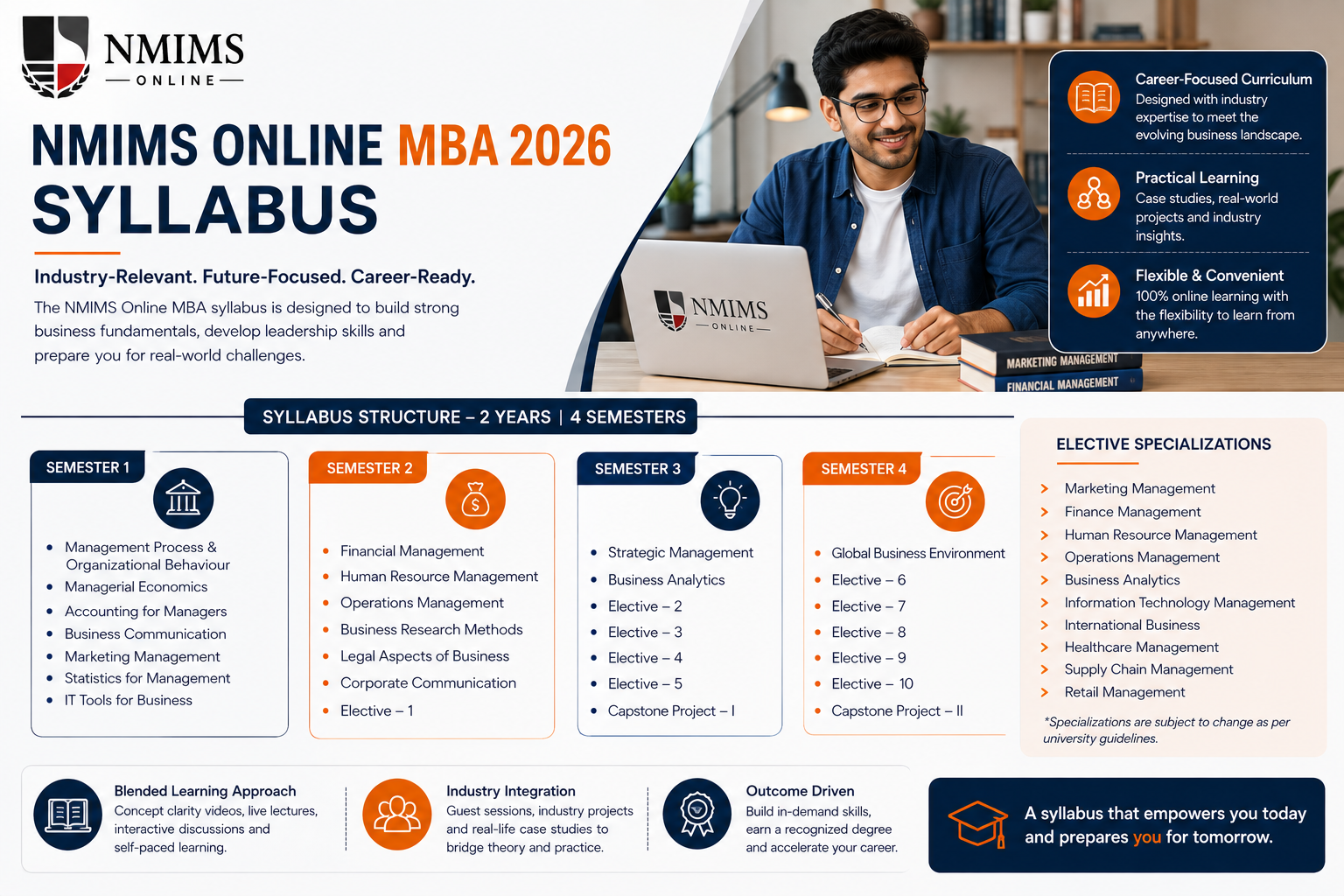
NMIMS Online MBA Business Management Syllabus
The first two semesters build common foundations. The Business Management identity becomes clearer in semesters three and four through its seven dedicated subjects and project work.
Semester 1: Management foundations
| Subject | Practical learning focus |
|---|---|
| Business Communication | Structure messages, reports and presentations for business audiences |
| Financial Accounting | Read how transactions affect statements and performance |
| Marketing Management | Understand customer value, markets and marketing decisions |
| Micro Economics and Macro Economics | Connect firm decisions with demand, competition and the wider economy |
| Organisational Behaviour | Understand individual and group behaviour at work |
| Quantitative Methods I | Use numerical reasoning to support decisions |
Semester 2: How organisations make and execute decisions
| Subject | Practical learning focus |
|---|---|
| Business Analytics | Use data to frame and examine business questions |
| Cost and Management Accounting | Connect operating choices with cost and managerial control |
| Legal Aspect of Business | Recognise the legal context around business activity |
| Strategic Management | Link choices, resources and execution priorities |
| Human Resource Management | Understand core people-management systems and decisions |
| Operations Management | Examine capacity, flow, quality and delivery |
Semester 3: Business Management subjects begin
The dedicated Business Management page currently lists:
- Corporate Finance
- Research Methodology
- Project pre-work
- Information Systems for Management
- Consumer Behaviour
- Organisational Theory, Structure and Design
- Supply Chain Management
Information Systems for Management helps a manager think about information, systems and business needs together. It is relevant when process and decision quality depend on reliable data or technology.
Consumer Behaviour examines why customers evaluate, select and use products or services. It can inform marketing, product, sales and service choices.
Organisational Theory, Structure and Design looks at how roles, reporting relationships and coordination shape execution. It becomes useful when a business grows, reorganises or works across several teams.
Supply Chain Management connects sourcing, movement, planning and delivery. Even managers outside logistics benefit from understanding how commercial promises depend on operational flow.
Semester 4: Growth, digital execution and projects
The official subject sequence currently lists:
- Corporate Sustainability
- Indian Ethos and Ethics
- International Business
- Project
- Entrepreneurship and Venture Capital Management
- Digital Marketing
- Project Management
Entrepreneurship and Venture Capital Management introduces opportunity evaluation, venture thinking and funding considerations. It is relevant to founders and to employees assessing new business initiatives.
Digital Marketing builds understanding of online customer acquisition, channels and measurement. The subject should be viewed as management education, not a substitute for hands-on platform practice.
Project Management supports planning, coordination, risk tracking and delivery. These skills are transferable across technology, operations, marketing, consulting and transformation work.
The final project provides a chance to integrate multiple subjects around one business problem.
How the 102 Credits Fit Together
The official curriculum lists 102 programme credits. The calculation is:
- Twelve common subjects in semesters one and two: 48 credits
- Corporate Finance and Research Methodology: 8 credits
- Seven Business Management subjects: 28 credits
- Three common semester-four subjects: 12 credits
- Project: 6 credits
- Total: 102 credits
What Skills Can This Specialisation Build?
| Capability | Subjects that contribute | Evidence a learner could create |
|---|---|---|
| Commercial understanding | Economics, marketing, finance and consumer behaviour | Market-entry or customer-opportunity analysis |
| Financial judgement | Accounting, cost accounting and corporate finance | Cost-impact model for a business choice |
| Cross-functional thinking | Strategy, organisation design and supply chain | Recommendation showing trade-offs across teams |
| Digital business awareness | Information systems and digital marketing | Process or channel improvement proposal |
| Execution discipline | Operations and project management | Scope, timeline, risk and stakeholder plan |
| Research and analysis | Quantitative methods, analytics and research methodology | Evidence-based study with clear assumptions |
| Responsible decisions | Law, ethics and sustainability | Risk and stakeholder review of a proposal |
| New-venture thinking | Entrepreneurship and venture capital | Business model and viability assessment |
Who Should Consider Business Management?
Professionals moving into general management
A specialist promoted into a wider role may need to understand finance, people, customers and delivery at the same time. This curriculum provides breadth across those areas.
Business development professionals
Growth roles often sit between the customer, commercial model and delivery team. Consumer behaviour, digital marketing, finance, information systems and project management can help connect an opportunity with its execution requirements.
Entrepreneurs and family-business members
Owners make cross-functional decisions daily. The programme can create a structured way to review pricing, organisation, marketing, systems, supply and new initiatives. The value increases when assignments are applied to a real, non-confidential problem.
Project and programme coordinators
Professionals who already coordinate timelines may need stronger commercial and organisation context. Project Management is only one subject; the wider curriculum explains why a project exists and how it affects the business.
Early-career learners who are still exploring
Breadth can help a learner discover areas of interest. However, someone with a clear technical direction may gain more from the matching focused specialisation.
Who May Prefer Another Specialisation?
Choose depth when the target role demands it.
| If your main goal is… | Compare Business Management with… |
|---|---|
| Financial analysis, banking or corporate finance | Finance Management |
| Brand, sales and specialised marketing work | Marketing Management |
| HR operations, talent or organisation development | Human Resources Management |
| Process, quality, logistics or supply chain depth | Operations and Data Sciences |
| Technology management, cyber risk or digital systems | Information Technology Management |
| Data modelling and analytics-led decisions | Business Analytics |
Business Management Career Relevance
Career examples such as business development and policy analysis. Treat these as possible role directions, not promised placements. Broader career areas may include:
- Business development and partnerships
- General operations and business coordination
- Project or programme support
- Management consulting support roles
- Entrepreneurial and family-business management
- Product or commercial operations
- Cross-functional transformation initiatives
Build a role bridge
For each target role, create a three-column plan:
| Existing proof | Capability to add | Evidence to produce during MBA |
|---|---|---|
| What you already do well | What the new role requires | Project, work example, case or portfolio item |
Project Ideas for Business Management Learners
A useful project crosses at least two management areas and has a clear decision at its centre.
- Evaluate a new-city expansion using demand, cost and delivery readiness.
- Analyse customer churn and propose process plus communication changes.
- Design a digital acquisition plan with unit economics and operational capacity.
- Study delays in a service process and recommend a project roadmap.
- Assess whether a small business should introduce an information system.
- Compare two sourcing models through cost, risk and customer impact.
- Build a growth plan for a family business with governance and role clarity.
- Evaluate a new product using customer, financial and execution evidence.
Learning Format and Assessment
NMIMS Online offers live and recorded learning, digital resources and Student Zone access. The programme page also lists internal assessment and term-end examination. This means learners need both regular coursework and examination preparation.
The format can work around employment, but it is not deadline-free. Ask for the current live timetable, assessment weightage, examination rules and project instructions before admission. Older learners’ screenshots may not reflect the active batch.
Eligibility, Fees and Admission Snapshot
The current eligibility requirement is a bachelor’s degree under 10+2+3 from a recognised university, or an AIU-recognised equivalent, with at least 50% marks and 45% for SC, ST, OBC and PwD candidates.
Current published fee options are:
- One-time programme fee: ₹1,96,000
- Annual fee: ₹1,05,000
- Semester fee: ₹55,000
- Admission-processing fee: ₹1,200
- Examination fee: ₹800 per subject per attempt
- Project fee: ₹800 per attempt
Applicants should also examine financing cost, device and connectivity needs, and any verified campus-activity travel.
Is NMIMS Online MBA Business Management Worth It?
Yes, the NMIMS Online MBA in Business Management can be worth it for working professionals who want to develop business and management skills without leaving their jobs. The program offers flexibility for learners who want to study alongside professional commitments while building knowledge in areas such as management, business strategy, and leadership.
However, whether the NMIMS Online MBA is worth it depends on your career goals, existing work experience, budget, and expected career outcomes. Reviewing the curriculum, fees, eligibility, learning experience, and career support can help you make an informed decision.
Conclusion
NMIMS Online MBA in Business Management is designed for breadth. Its subjects move from core management foundations into systems, customers, organisation design, supply chain, entrepreneurship, digital marketing and project execution. Choose it when the next role requires cross-functional judgement. If your goal demands deep finance, marketing, HR, operations, IT or analytics capability, compare the dedicated specialisation before deciding. In either case, verify the active syllabus and build evidence that shows how you used what you learned.
Frequently Asked Questions
It is a two-year MBA Online specialisation that combines common management foundations with cross-functional subjects in systems, customers, organisation, supply, entrepreneurship, digital marketing and projects.