Table of Content
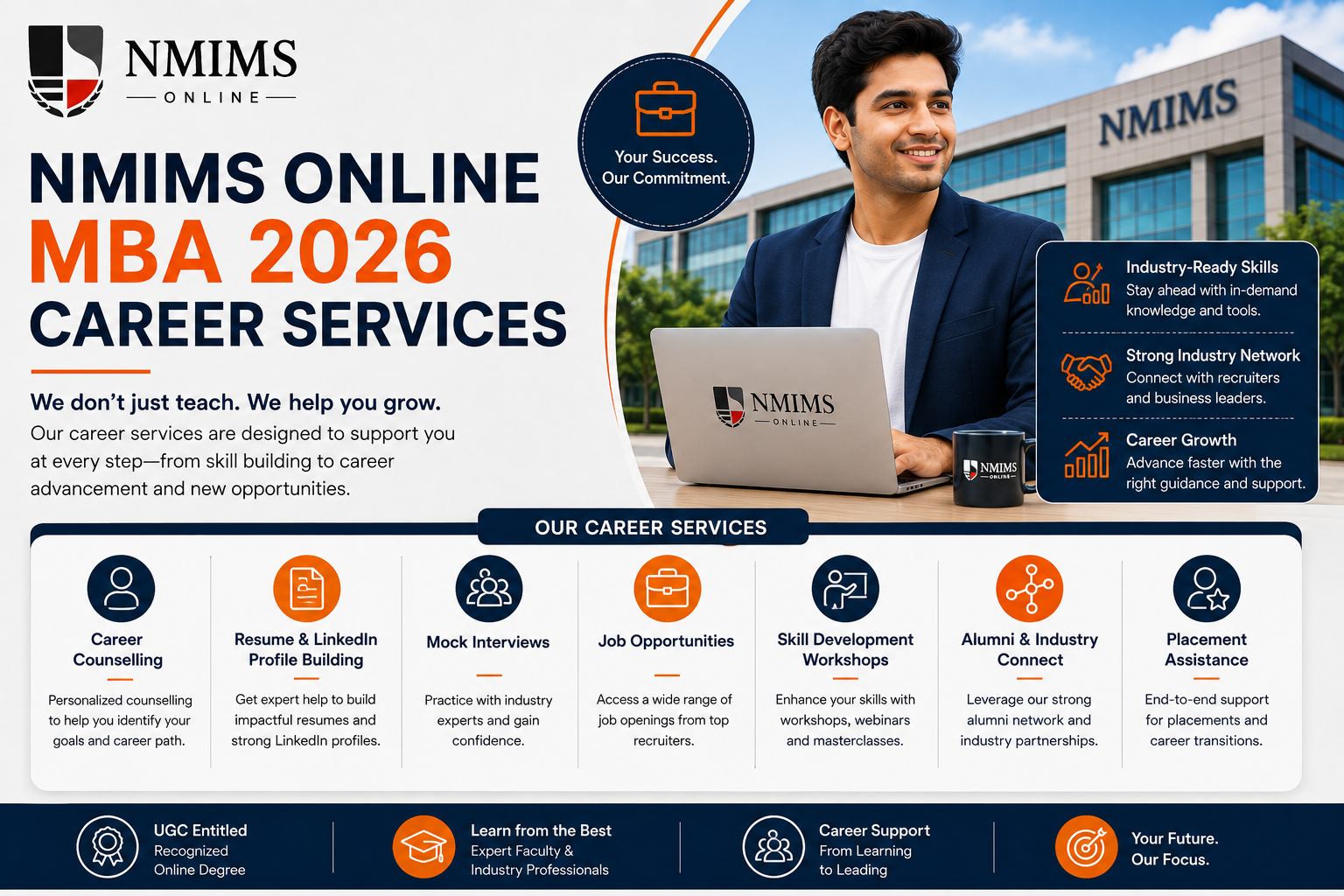
NMIMS Online MBA career services currently include six months of access to selected job portals, career coaching, profile development, practice interviews and assessment support. These services can improve preparation and opportunity discovery. They do not guarantee placement, a minimum salary, promotion or a successful career switch.
This distinction matters because "placement assistance" and "placement" are not the same service.
NMIMS Online MBA Career Support at a Glance
| Published service | What it is designed to support | What it does not guarantee |
|---|---|---|
| Job-portal access | Discover and apply to relevant openings | Recruiter response or job offer |
| Career coaching | Clarify direction and build a transition plan | Successful career change |
| Profile development | Improve CV, LinkedIn profile and positioning | Automatic shortlisting |
| Practice interviews | Strengthen answers and receive feedback | Selection in a real interview |
| Assessments | Understand cognitive or behavioural strengths | Eligibility for a specific role |
Does NMIMS Online MBA Provide Placement?
NMIMS publishes career-development and job-search support, but the current pages should not be interpreted as a promise that the university will place every Online MBA learner.
A guaranteed-placement claim would need clear written conditions, cohort coverage and outcome evidence.
The more accurate answer is:
- Yes, career assistance is published.
- No, an employment outcome is not guaranteed.
This is not only a legal distinction. It changes how the learner should use the service. Waiting for a recruiter to arrive is passive. Building a target list, evidence, network and interview readiness is active.
Start Your Journey
Want Career Support That Fits Your Goals?
Talk to our admissions team about job-portal access, coaching, and how career services connect to your specialisation.
Job-Portal Access
Six months of access to portals such as IIMJobs, Updazz and Hirist. They also mention personalised job recommendations, application visibility and company information.
What the portal may help with
- Finding openings in one place
- Filtering by function, experience or location
- Discovering employers outside your existing network
- Comparing role requirements
- Testing whether your profile matches market language
- Organising applications
What the portal cannot control
- Number of suitable vacancies during your access period
- Employer eligibility criteria
- Whether a recruiter opens the application
- Interview selection
- Salary offered
- Location or work-mode availability
- Final hiring decision
How to use the six-month window well
Do not begin by applying to everything. Use the first stage to identify patterns.
- Save 20 relevant job descriptions.
- Mark repeated skills, tools and experience requirements.
- Separate gaps into knowledge, evidence and experience.
- Update the profile around genuine strengths.
- Apply selectively and track the response.
- Change the approach when a pattern shows no traction.
A portal is most useful when it becomes a source of market evidence, not only a place to upload a résumé.
Career Coaching
NMIMS describes personalised coaching for career transition and professional goals. A coaching conversation can help a learner clarify direction, test assumptions and convert a broad ambition into actions.
Prepare before a coaching session
Bring:
- Current résumé
- Two or three target role descriptions
- Your preferred industries and locations
- A list of major achievements
- The specialisation and relevant project work
- Specific questions or decisions
"How do I get a better job?" is too broad. Better questions include:
- My experience is in network operations. Which adjacent management roles use it?
- My target roles repeatedly ask for financial modelling. How can I build credible evidence?
- Should I pursue an internal move before an external switch?
- How should I explain an employment gap without making it the centre of my profile?
What coaching cannot replace
A coach can challenge and guide the plan. They cannot create experience that the learner does not have, guarantee recruiter interest or make a highly unrealistic switch become immediate.
Profile Development
CV guidance, LinkedIn optimization, social-media profiling and personal branding.
Profile development should not mean adding fashionable keywords or inflating responsibility. Its purpose is to make relevant evidence easy to understand.
A stronger résumé structure
Use each major bullet to show:
- The business or operating context
- The action you personally took
- The scale involved
- The measurable result where evidence exists
- The capability relevant to the target role
For example, "responsible for operations" is vague. "Redesigned the weekly escalation process for a 12-person support team, reducing unresolved priority tickets" gives more context. Use a number only when it is documented.
Using the Online MBA on a résumé
Add the specialisation and expected or completed year as appropriate. Relevant projects can appear in a separate section when they demonstrate a capability the target role requires.
Do not imply that an academic case study was paid employment or that enrolment has already resulted in the degree.
LinkedIn profile improvement
A useful profile should align four elements:
- Headline: current value and intended direction
- About section: experience, capability and focus
- Experience: evidence of work rather than duty lists
- Featured section: relevant projects, presentations or credible work samples
Optimisation should improve clarity, not turn every line into search terms.
Practice Interviews
NMIMS describes personalised interview practice and expert feedback for jobs, promotions and domain changes.
The value of a practice interview comes from repeated improvement. One session can expose problems, but the learner must revise and practise again.
Build a story bank
Prepare examples covering:
- A difficult problem
- A decision made with incomplete information
- A conflict or stakeholder disagreement
- A process improvement
- A failure and what changed afterward
- Leadership without formal authority
- A numerical or analytical decision
- A situation connected to the chosen specialisation
Use a simple structure: context, responsibility, action and result. The story should answer the question instead of reciting a prepared speech.
For career switchers
Expect questions about why the change makes sense and what proves readiness. The MBA provides part of the answer. A stronger response also connects previous strengths, new learning, practical evidence and the target role.
For promotion interviews
Show how the learner already handles part of the next level's scope. Course completion alone is not proof of leadership readiness.
Career Assessments
Aptitude and psychometric assessments used to examine cognitive or behavioural skills and support career-path understanding.
An assessment can create useful language for reflection, but it should not become a fixed label. Results can depend on the instrument, context and interpretation.
Use an assessment to ask:
- Which strengths are already visible in my work?
- Which claims need evidence?
- Which environments help me perform well?
- What capability needs development?
- Does the suggested direction match real role requirements?
Career Support by Specialisation
The specialisation can help focus preparation, but it does not create automatic role eligibility.
| Specialisation | Evidence worth developing | Illustrative role families to research |
|---|---|---|
| Business Management | Cross-functional business case, growth analysis | General management, business operations, programme coordination |
| Marketing Management | Customer research, campaign or funnel analysis | Marketing, sales strategy, brand, customer growth |
| Finance Management | Financial analysis, budget or valuation case | FP&A, financial analysis, commercial finance |
| Human Resources Management | Workforce, onboarding or skill-gap study | HR operations, talent, learning, people analytics |
| Operations and Data Sciences | Process map and improvement case | Operations, supply chain, quality, service delivery |
| IT Management | Technology business case or change plan | IT management, programme delivery, product operations |
| Business Analytics | Data-to-decision portfolio case | Business analysis, reporting, decision support |
A 12-Week Career Services Action Plan
Weeks 1–2: Define the target
- Choose one primary role family.
- Collect 20 relevant job descriptions.
- Identify repeated requirements.
- Write down the current strengths and gaps.
Weeks 3–4: Rebuild the profile
- Rewrite the résumé around evidence.
- Align LinkedIn with the same direction.
- Remove claims that cannot be supported.
- Add one relevant academic or work project.
Weeks 5–6: Build proof
- Select one missing capability.
- Create a case, analysis or portfolio item.
- Ask a practitioner whether the output resembles real work.
Weeks 7–8: Develop the market network
- Speak with people performing the target role.
- Ask about tasks, hiring criteria and common gaps.
- Avoid opening every conversation with a referral request.
Weeks 9–10: Practise interviews
- Build eight evidence-backed stories.
- Record responses and remove unnecessary detail.
- Practise role-specific questions.
- Use feedback to revise the weakest examples.
Weeks 11–12: Apply and learn
- Apply selectively.
- Track role, date, source and response.
- Review which applications receive attention.
- Change positioning when evidence suggests a mismatch.
The plan can continue beyond 12 weeks. Its value lies in producing a repeatable system.
Career Outcomes: What Actually Drives Them?
| Outcome driver | Why it matters |
|---|---|
| Previous experience | Shows whether the learner has handled similar responsibility |
| Specialisation relevance | Connects curriculum to the target work |
| Demonstrated results | Gives employers evidence beyond course completion |
| Role demand | Influences vacancies, competition and salary |
| Location and work mode | Changes the available opportunity set |
| Communication | Affects résumé clarity and interview performance |
| Network | Improves market information and opportunity discovery |
| Consistent execution | Determines whether support tools become real actions |
Salary Expectations After NMIMS Online MBA
Do not use one "average salary after NMIMS Online MBA" unless it comes from a transparent report for the same programme and cohort.
Salary depends on:
- Current compensation
- Years and relevance of experience
- Function and industry
- Location
- Employer size and pay structure
- Scope of the new role
- Negotiation and competing offers
- Market conditions
Red Flags in Placement Claims
Be cautious when an affiliate or counsellor says:
- "100% placement guaranteed"
- "Every learner receives interviews"
- "A fixed salary is assured"
- "The Online MBA has the same placement process as the residential MBA"
- "The university will approve your career switch"
- "Pay now to reserve a job opportunity"
Questions to Ask About Career Services
- Are the modules included in the programme fee?
- Which MBA Online students and alumni can access them?
- When does the six-month job-portal period begin?
- Can the learner choose when to activate access?
- How many coaching or practice-interview sessions are included?
- Are there eligibility or completion conditions?
- Which current portals are provided?
- Does access continue after graduation?
- How are appointments booked?
- What support is available if a portal account fails?
Conclusion
NMIMS Online MBA career services can be useful when learners treat them as tools for action. Job portals can reveal opportunities. Coaching can sharpen direction. Profile and interview support can improve presentation. None of them can replace relevant experience, evidence or employer demand. Enroll with a career plan, not a placement assumption.
Frequently Asked Questions
NMIMS publishes career assistance, including portal access and preparation tools. It does not state that every learner is guaranteed placement.