Table of Content
NMIMS Online MBA for Career Switch: Quick Verdict
| Switch situation | Relative difficulty | What the MBA may contribute | What must come from the learner |
|---|---|---|---|
| Same function, new industry | Moderate | Broader business context and industry-facing project | Industry vocabulary, network and relevant examples |
| New function, same industry | Moderate to high | Functional foundation and specialisation subjects | Tools, bridge assignments and proof of capability |
| New function and new industry | High | Structured learning and a clearer transition story | Adjacent role, portfolio, network and realistic level |
| Promotion into management | Depends on opportunity | Finance, people, operations and decision breadth | Performance, leadership evidence and internal sponsorship |
| Return after a career break | Depends on recency | Current knowledge and a formal learning signal | Recent projects, confidence, tools and re-entry strategy |
First Define What “Career Switch” Means
A career has at least four moving parts:
- Function: marketing, finance, HR, operations, analytics, IT or another area.
- Industry: banking, technology, manufacturing, retail, logistics, healthcare or another sector.
- Seniority: executive, analyst, specialist, manager or leader.
- Work context: company size, geography, product, customer type and operating model.
Changing one element is easier to explain than changing all four. For example:
- A manufacturing supervisor moving into operations analysis changes responsibility while retaining industry knowledge.
- A software engineer moving into IT business analysis retains technology context while adding business-process work.
- A salesperson moving into marketing operations retains customer knowledge while building campaign and analytics capability.
- An HR executive moving into business analytics changes function and may need a larger technical bridge.
Start Your Journey
Need Help Picking the Right Fee Route?
Talk to our admissions team about tuition options, complete cost and how each route affects your cash flow.
What the Programme Can Add to a Career Transition
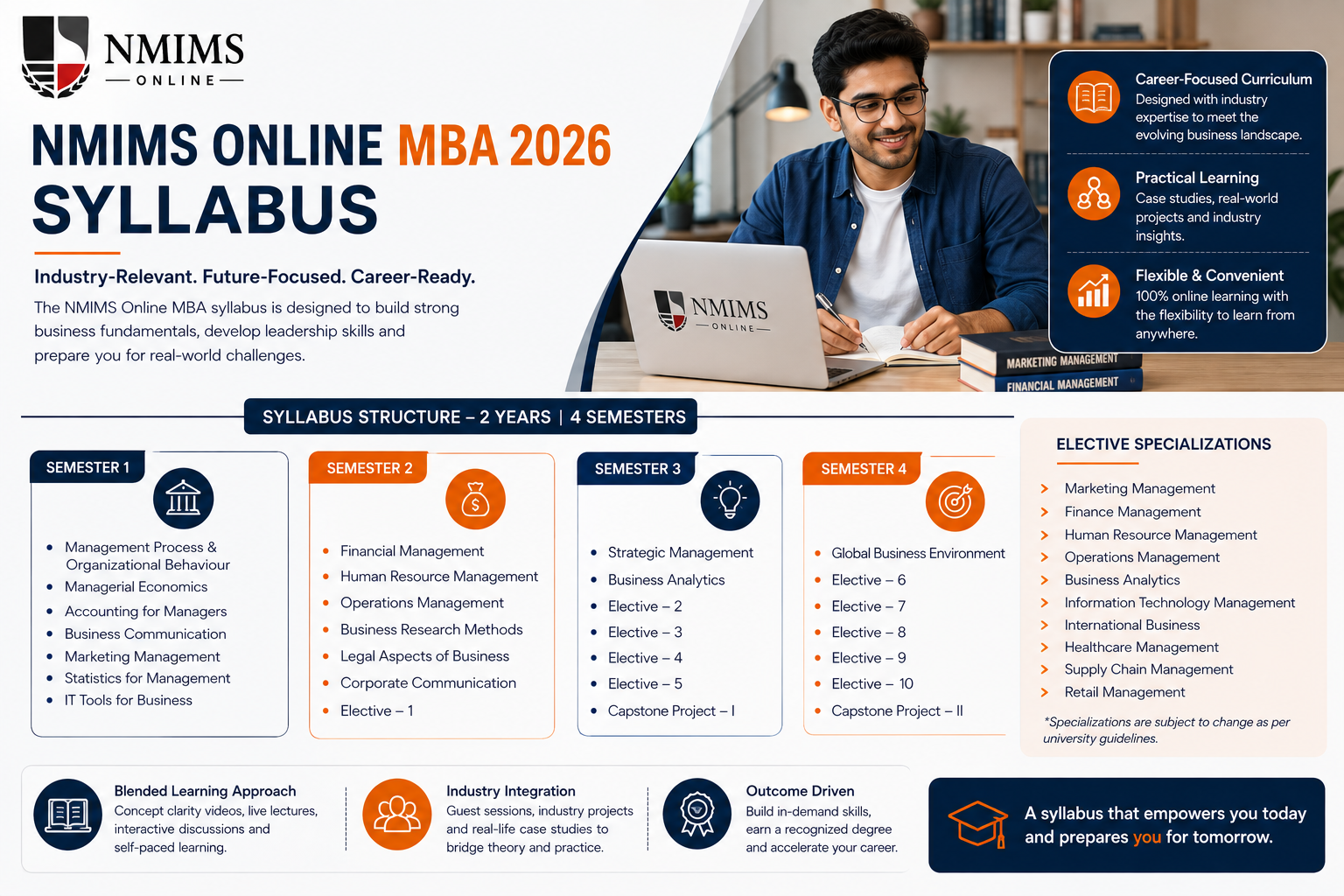
The official NMIMS MBA Online structure currently includes two years, four semesters, a four-year validity period, Internal Assessment plus Term-End Examination, specialisation subjects and an applied project.
A broad management foundation
Early study covers areas such as communication, accounting, economics, marketing, organisational behaviour, quantitative methods, business analytics, law, strategy, HR and operations. This can help a specialist understand how the target function connects to the wider business.
A functional direction
Seven published specialisations let a learner add depth in Business Management, Marketing, Financial Management, Human Resource Management, Operations and Data Sciences, Business Analytics or Information Technology Management.
An applied project
The project can demonstrate problem definition, method, analysis and recommendation when the topic is relevant and confidential information is protected. A good project does not guarantee a job, but it can make the transition story more concrete.
A disciplined completion signal
Completing a multi-semester degree while working may show persistence and time management. Employers will still look for evidence that the learning changed what the candidate can do.
Career-preparation services
NMIMS currently publishes career coaching, profile development, practice interviews, assessment and six months of job-portal access for eligible students and alumni. These services can support planning and execution, not guarantee the transition.
Match the Specialisation to the Bridge You Need
| Current background | Possible target direction | Relevant NMIMS specialisation to examine | Additional bridge evidence |
|---|---|---|---|
| Sales or customer service | Marketing operations, CRM or growth support | Marketing Management or Business Management | Funnel analysis, CRM exposure, campaign case |
| Accounting or commerce | Financial analysis, FP&A support or credit | Financial Management or Business Analytics | Modelling, variance analysis, sector knowledge |
| Engineering or production | Operations, supply chain, project or analytics | Operations and Data Sciences, Business Analytics or IT Management | Process map, data work, quality or cost case |
| Software or IT support | IT business analysis, service or project management | Information Technology Management or Business Analytics | Requirements, process, stakeholder or delivery evidence |
| HR administration | Talent, L&D, performance or people analytics | Human Resource Management or Business Analytics | Workforce analysis, HRIS or programme design |
| Small business or entrepreneurship | Business operations, growth or management | Business Management, Marketing or Finance | Unit economics, process and customer evidence |
| General graduate with limited experience | Entry analyst or coordinator role | Select after target-role research | Internships, tools, project and communication |
The Career-Switch Gap Analysis
Create four columns for the target role.
1. Business responsibility
What decision, process, customer or result does the role own? Examples include forecast accuracy, campaign conversion, employee retention, service quality, product adoption or project delivery.
2. Functional knowledge
What concepts must the candidate understand? These may include financial statements, performance marketing, workforce planning, inventory, requirements or data interpretation.
3. Tools and methods
List the actual tools repeated in job descriptions. Do not learn every trending tool. Prioritise those that appear in the intended role and industry.
4. Experience boundary
Identify requirements the MBA cannot replace: years of domain experience, regulated qualifications, people-management exposure, a technical portfolio or specific scale.
Then label each item:
- Already proven: You have credible evidence.
- Can build during the MBA: A course, project or current-job assignment can create evidence.
- Needs a separate bridge: It requires a tool course, volunteer project, lateral assignment or entry-level transition.
- Long-term: It cannot reasonably be built before the first switch.
Choose an Adjacent Bridge Role
A bridge role uses enough of the current profile to reduce employer risk while moving closer to the destination.
| Long-term goal | Possible bridge role | Transferable value retained |
|---|---|---|
| Product Manager | Business analyst, product operations or project coordinator | Customer, process, technical or delivery knowledge |
| Finance Manager | Financial analyst, reporting or FP&A support | Accounting, commercial or analytical experience |
| Marketing Manager | Campaign, CRM, content operations or market-research role | Customer, sales, communication or channel experience |
| HR Business Partner | HR operations, talent, L&D or people-analytics role | Employee-process and stakeholder experience |
| Operations Manager | Operations analyst, process excellence or supply-chain coordinator | Delivery, quality, production or service knowledge |
| Analytics Manager | Business analyst, BI analyst or functional analytics role | Domain knowledge plus growing data capability |
Turn Coursework Into Career Evidence
Use a real business question
Start with a decision, not a generic topic. “Why are customer renewals falling?” is more useful than “a study of marketing.”
Make the method visible
Explain data source, assumptions, analysis and limitations. A polished chart without a clear question is weak evidence.
Recommend an action
Management work ends with a decision or next step. State what should change, who would own it, what it may cost and how success would be measured.
Protect confidential information
Anonymise company, customer and employee data. Obtain permission before using workplace information. Never publish assessment answers or proprietary documents.
Build one sample per semester
- Semester 1: business problem and financial or customer diagnosis.
- Semester 2: process, people or market analysis.
- Semester 3: specialisation-focused work sample.
- Semester 4: integrated project with a recommendation and measurement plan.
Four relevant samples are stronger than a large folder of unrelated certificates.
Use NMIMS Career Services Deliberately
The official Career Change Coaching page describes career architecting, functional coaching, transition guidance, mentoring, self-assessment, learning resources and collaborative planning. Use these services with specific inputs.
Before coaching, prepare:
- Current role and strongest achievements.
- One primary and one backup target role.
- Ten current job descriptions.
- A gap matrix.
- Existing work samples.
- Constraints on salary, location and timeline.
During profile development, remove a generic “seeking managerial opportunities” summary. Replace it with a target and evidence. During practice interviews, test whether the story explains why the switch is logical, what has already been built and why the candidate is applying at that level.
A 180-Day Career-Switch Plan
| Period | Main action | Output |
|---|---|---|
| Days 1-15 | Select one role family and collect 15 job descriptions | Role-requirements matrix |
| Days 16-30 | Map transferable experience and gaps | Prioritised bridge plan |
| Days 31-60 | Learn one repeated tool or method | Small demonstrable work sample |
| Days 61-90 | Apply coursework to a role-relevant problem | Portfolio case with recommendation |
| Days 91-120 | Speak with professionals in the target field | Better vocabulary, reality check and referrals |
| Days 121-145 | Rewrite CV and LinkedIn around evidence | Role-aligned professional profile |
| Days 146-165 | Practise technical and behavioural interviews | Eight strong stories and gap responses |
| Days 166-180 | Apply to bridge and target roles; track outcomes | Application funnel and adjustment plan |
How to Rewrite the Career Story
A transition narrative should answer four questions:
- What useful capability comes from the current career?
- Why is the target role a logical next direction?
- What has the learner done to close the gap?
- What evidence shows readiness now?
Example structure:
“I have four years of experience improving service operations and coordinating customer issues. I am moving toward business operations because I want to own process and performance decisions. Through the MBA and a process-analysis project, I have built financial, analytics and stakeholder-planning capability. I am targeting an operations-analyst or process-excellence role where my service knowledge remains useful.”
Common Career-Switch Mistakes
- Selecting a specialisation before choosing a target role.
- Attempting a new function, industry and seniority in one move.
- Treating the degree as a replacement for required tools.
- Applying only to manager titles without management evidence.
- Creating generic projects unrelated to the target work.
- Hiding the Online mode instead of explaining the choice honestly.
- Collecting certificates without producing a useful work sample.
- Expecting the job portal to conduct the search automatically.
- Rejecting an adjacent bridge role that would close the main gap.
- Using a promised salary increase to justify the entire decision.
Conclusion
The NMIMS Online MBA can provide a structured pathway for professionals planning a career switch through management knowledge, relevant specializations, applied projects, and career-preparation support. However, a successful transition requires more than earning a degree. Learners must identify realistic target roles, build transferable skills, gain practical experience, and demonstrate their capabilities through relevant projects. With a clear Career Strategy, consistent skill development, and effective networking, students can use the program as a stepping stone toward new professional opportunities.
Frequently Asked Questions
It can provide management knowledge, specialisation and career-preparation support. The switch still requires a suitable target, transferable experience, role tools, evidence, networking and employer selection.