Table of Content
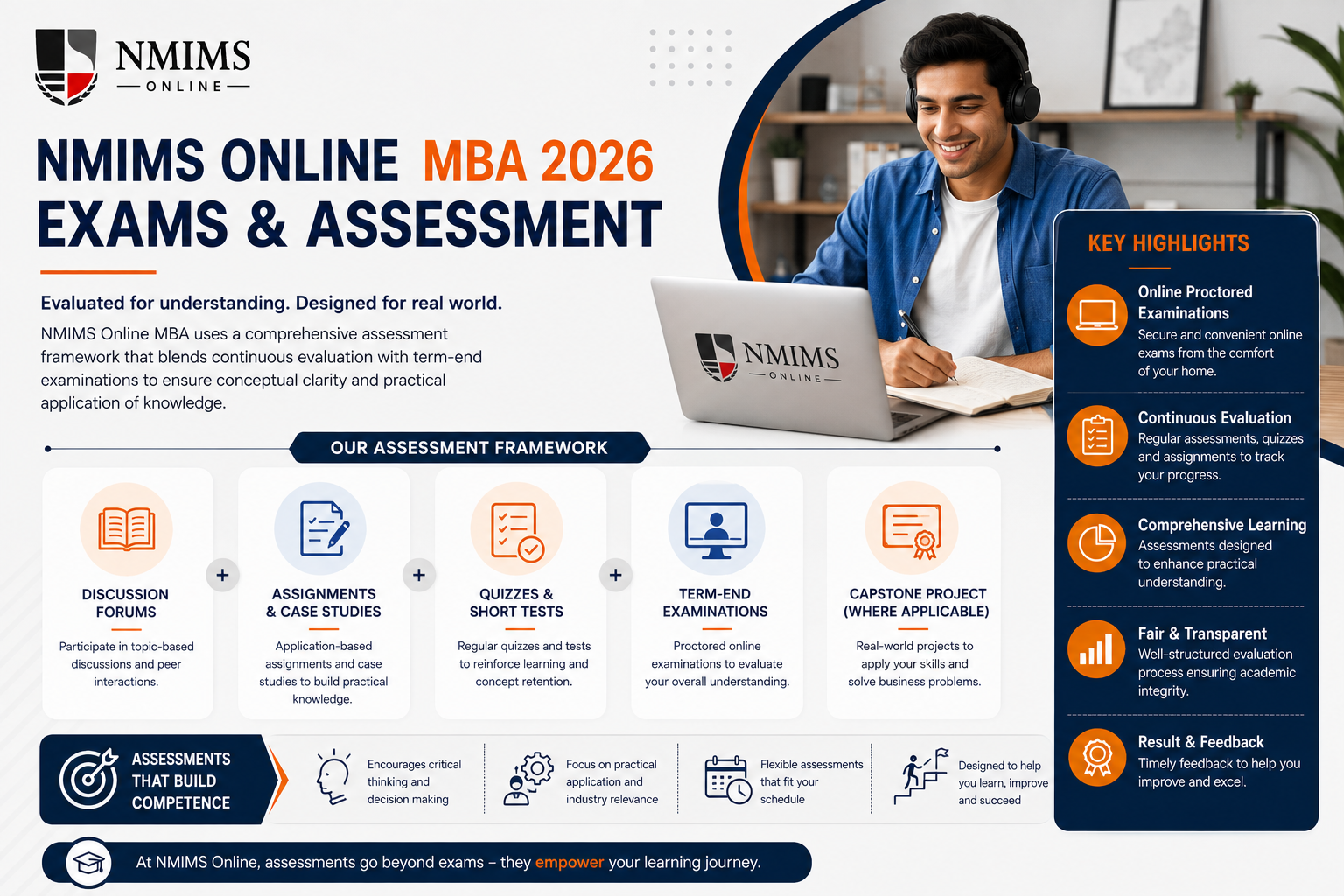
NMIMS summarises Online MBA evaluation as Internal Assessment plus Term-End Examination, with a project component later in the programme. Official CDOE examination information describes application-oriented assignments and a composite question paper containing objective and descriptive components. Current weightage, mode, dates and conduct rules must be confirmed through the Student Portal.
The official programme fee is ₹800 per subject, per attempt, and a project fee of ₹800 per attempt.
NMIMS Online MBA Assessment at a Glance
| Assessment component | Published description | What to verify for your batch |
|---|---|---|
| Internal Assessment | Academic work completed during the term | Format, weightage, deadline and submission rules |
| Term-End Examination | End-of-cycle examination | Mode, question distribution, duration and conduct rules |
| Project | Applied report in the later programme stage | Topic process, supervision, format and evaluation |
| Examination fee | ₹800 per subject, per attempt | Registration and payment deadline |
| Project fee | ₹800 per attempt | When the charge becomes due |
How Are NMIMS Online MBA Learners Evaluated?
The programme hub uses the short form IA + TEE.
- IA means Internal Assessment.
- TEE means Term-End Examination.
The CDOE examination information page explains that programme evaluation can combine assignments, examinations and a project report. It describes assignments as case-based and application-oriented. It also states that examinations include objective and application-oriented components.
Start Your Journey
Need Help Understanding How Exams Work?
Talk to our admissions team about the assessment pattern, exam mode, project process and fees for your batch.
Internal Assessment
Internal Assessment allows the programme to evaluate learning during the semester rather than depending only on one final examination.
The exact format may include assignments, cases, quizzes or other academic tasks according to the current course and Student Portal instructions.
What case-based assessment requires
A case normally presents a business situation. A strong response should:
- Identify the real question
- Select relevant concepts
- Apply them to the facts
- State assumptions
- Explain the reasoning
- Recommend an action where requested
- Acknowledge external sources
How to plan internal work
- Read the task on the day it opens.
- Record the deadline in a personal calendar.
- Break the work into research, analysis, drafting and review.
- Check the required word limit or file format.
- Preserve sources while researching.
- Upload before the final hour.
- Save the submission acknowledgement.
Academic integrity
Assignments should reflect the learner's own reasoning. Do not use purchased answers, copied submissions or services that promise to bypass plagiarism checks.
Generative tools, external editors or collaboration may be restricted by the current academic-integrity policy. Follow the university rule applicable to the assignment. When outside material is allowed, cite it properly.
Term-End Examination
The Term-End Examination assesses the subjects registered in the examination cycle.
It is a composite paper with marks reserved for Multiple Choice Questions and descriptive questions. It also refers to objective and application-oriented components.
That public page should not be treated as a permanent promise of the exact question count, weightage or delivery method. Verify the active examination notice for:
- Examination mode
- Registration window
- Subject selection
- Date and time
- Duration
- Identification requirements
- Device or centre requirements
- Permitted materials
- Question distribution
- Technical-support process
- Result and reappearance policy
Objective questions
Objective questions can test concepts, distinctions, calculations and recognition of the best response. They reward accurate understanding, but guessing is not a reliable strategy.
Prepare by using retrieval practice rather than only rereading notes. Short self-tests can reveal gaps earlier.
Descriptive and application-oriented questions
Descriptive answers should be structured. A useful approach is:
- Begin with the direct answer.
- Define only the concepts needed.
- Apply them to the scenario.
- Use steps, calculations or a framework where relevant.
- State the practical implication.
- Conclude without repeating the entire response.
Is the NMIMS Online MBA Exam Online?
The programme itself is online, and search queries commonly use the phrase “online exam.” However, exam delivery and proctoring arrangements can change by cycle or policy.
The public sources checked for this guide did not provide enough current operational detail to promise that every examination is completed from home under the same conditions.
Use the current Student Portal notice to confirm:
- Remote or centre-based mode
- Proctoring requirements
- Approved device and browser
- Webcam or microphone requirements
- Internet specifications
- Room or identity checks
- Permitted location
Examination Registration and Fees
The programme fee is currently ₹800 per subject, per attempt.
The wording means:
- The fee is calculated for each registered subject.
- A repeat attempt can create another charge.
Use this formula:
Examination fee = Number of chargeable subject attempts × ₹800
If a learner registers for six chargeable subject attempts in one cycle, the amount at the current rate would be ₹4,800. This is a calculation example, not a statement that every semester always has six chargeable subjects.
The NMIMS Online MBA Project
The programme structure includes a project carrying six credits. Examination information also describes a project report requirement for MBA Online learners.
The current fee note lists ₹800 per project attempt.
Purpose of the project
The project gives the learner an opportunity to integrate management knowledge around one focused problem. It should demonstrate question framing, evidence, analysis and recommendation.
Choosing a workable topic
A good topic is:
- Relevant to the specialisation
- Narrow enough to complete
- Supported by accessible evidence
- Ethical and non-confidential
- Connected to a management decision
Examples of directions include:
- Customer retention analysis for a defined segment
- Working-capital improvement in a small enterprise
- Onboarding effectiveness in a team
- Process delay analysis in a service workflow
- Dashboard design for an operating decision
- Business case for a technology change
These are directions, not ready-made project titles. The final topic should follow the current approval process.
Project workflow
- Identify the problem.
- Review what is already known.
- Write a focused objective or research question.
- Select an appropriate method.
- Obtain or collect evidence ethically.
- Analyse the evidence.
- Explain findings and limitations.
- Recommend action.
- Format and cite the report.
- Submit through the authorised route.
Protecting workplace information
Do not upload confidential customer, employee, financial or system data without permission. Anonymise evidence and follow organisational policy. When real data cannot be used safely, select a public or simulated case allowed by the academic rules.
A Semester Assessment Timeline
Exact dates will differ, but the planning sequence can remain consistent.
Early semester
- Download the subject outline.
- Record every known deadline.
- Identify quantitative or unfamiliar topics.
- Set weekly study blocks.
Mid-semester
- Begin internal assessment early.
- Ask academic questions through the portal.
- Maintain a subject-wise revision sheet.
- Review whether work commitments will conflict with examination registration.
Before the examination window
- Complete registration and fee payment.
- Verify subject selection and timetable.
- Review current conduct and technology rules.
- Practise objective and applied questions.
- Prepare a fallback plan for a genuine technical issue according to policy.
After the examination
- Preserve attendance or completion evidence where provided.
- Check results through the portal.
- Use the formal query, revaluation or reappearance route when applicable.
- Do not rely on a messaging group for the final rule.
An Eight-Week Examination Preparation Plan
Weeks 1–2: Map the syllabus
- Divide each subject into major units.
- Mark topics that require calculation or repeated practice.
- Collect official resources.
Weeks 3–4: Build understanding
- Create short notes in your own words.
- Solve concept checks.
- Connect every topic to a business example.
Weeks 5–6: Practise application
- Work through case questions.
- Time selected descriptive responses.
- Review errors and revise the weak topic.
Week 7: Integrate
- Complete mixed-topic revision.
- Practise retrieving concepts without notes.
- Review formulas, frameworks and common distinctions.
Week 8: Prepare for execution
- Follow the official timetable.
- Confirm technical or centre requirements.
- Sleep adequately and avoid learning the entire subject in the final night.
Working professionals may need shorter daily blocks plus a longer weekend session. Consistency is more important than one unrealistic study target.
How to Answer Case-Based Questions
Use the Issue–Concept–Application–Recommendation structure.
Issue
State the decision or problem in one or two sentences.
Concept
Identify the relevant model, principle or method. Do not list every theory from the chapter.
Application
Connect the concept to the facts in the case. Explain why the evidence supports the interpretation.
Recommendation
Give a practical action, including trade-offs or limitations where relevant.
This approach keeps the response focused and reduces the chance of writing a generic essay.
What Happens If You Miss or Fail an Assessment?
The exact reappearance, resubmission, carry-forward and validity rules must come from the current university policy. Do not assume that an older student's experience applies to your batch.
Immediately check:
- Whether another attempt is available
- The registration window
- Applicable fee
- Whether internal marks carry forward
- Whether the subject must be repeated completely
- Impact on progression or completion
- Maximum programme-validity limit
Raise a ticket when an absence was caused by a documented exceptional or technical issue. Approval is not automatic.
Common Examination Mistakes
- Waiting for the exam calendar before starting revision
- Missing the subject-registration deadline
- Treating recordings as passive background content
- Memorising definitions without practising cases
- Ignoring the current technology or identification rule
- Uploading an assignment at the final minute
- Copying answers or using unapproved assistance
- Assuming the exam fee is included in tuition
- Using a past paper as proof of the current pattern
- Sharing credentials with a third party
Conclusion
NMIMS Online MBA assessment combines ongoing academic work, term-end examinations and a final project. Learners should prepare for both concept recall and business application. The safest approach is to start early, register on time, preserve submissions and follow the current Student Portal rule. Never turn an old calendar or question paper into a promise about the current exam cycle.
Frequently Asked Questions
The programme hub summarises evaluation as Internal Assessment plus Term-End Examination, with a project component later in the programme.