Table of Content
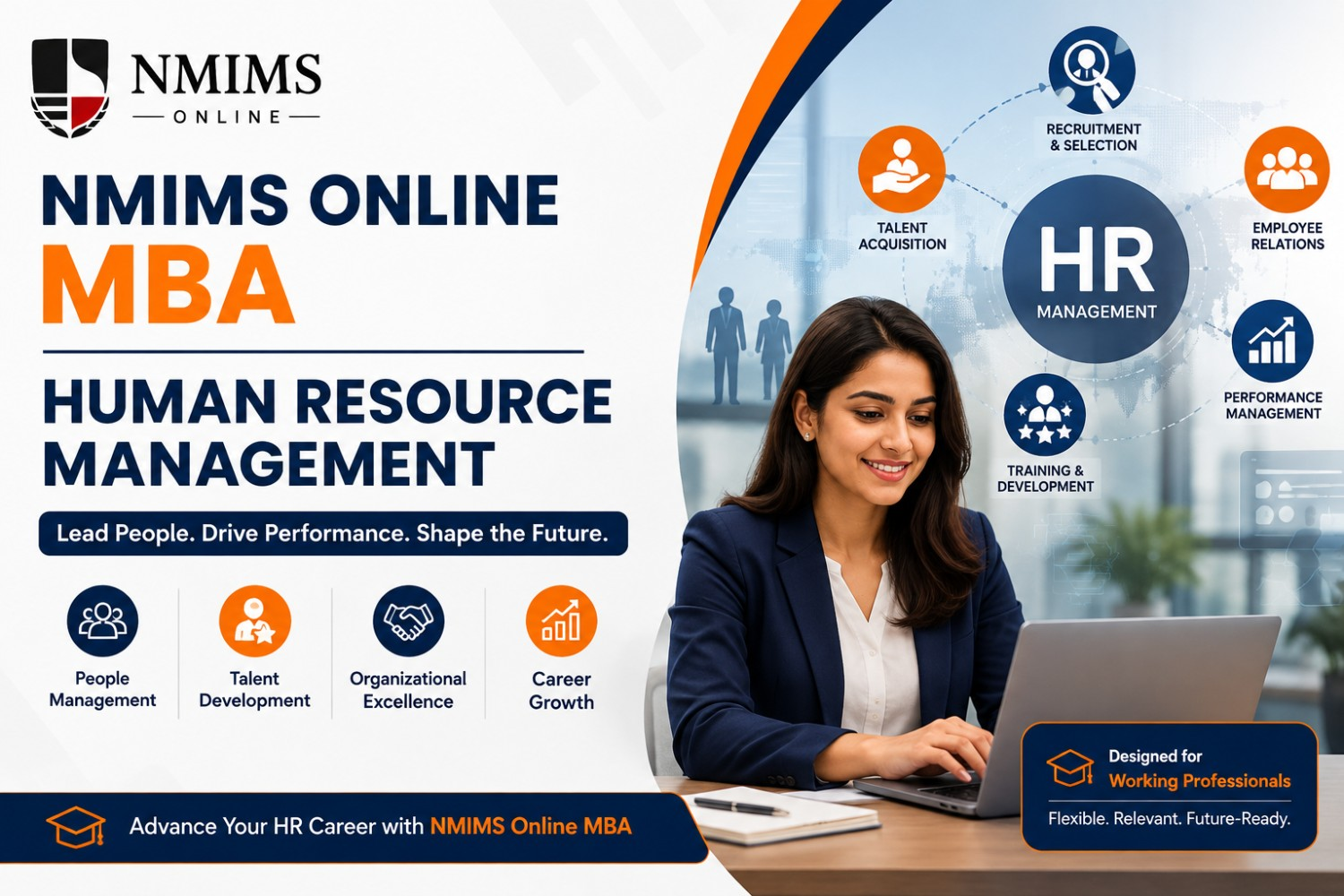
The NMIMS Online MBA in Human Resource Management covers the systems used to attract, reward, develop, evaluate and retain people at work. Its seven HR subjects are Compensation and Benefits, Industrial Relations and Labour Laws, Manpower Planning, Recruitment and Selection, Organisational Development and Change, Performance Management System, Learning and Development, and Emotional Intelligence.
This is not a recruitment-only programme. It connects workforce decisions with business strategy, cost, law, analytics, operations and organisational performance. It may suit HR professionals, people managers and career switchers who can build evidence beyond the degree.
NMIMS Online MBA HR: Programme Snapshot
| Feature | Current published detail |
|---|---|
| Duration | 2 years |
| Semesters | 4 |
| Validity window | 4 years |
| Evaluation | Internal assessment and term-end examination |
| Total credits | 102 in the detailed MBA structure |
| HR specialisation papers | 7 |
| Learning access | Live and recorded sessions plus digital resources |
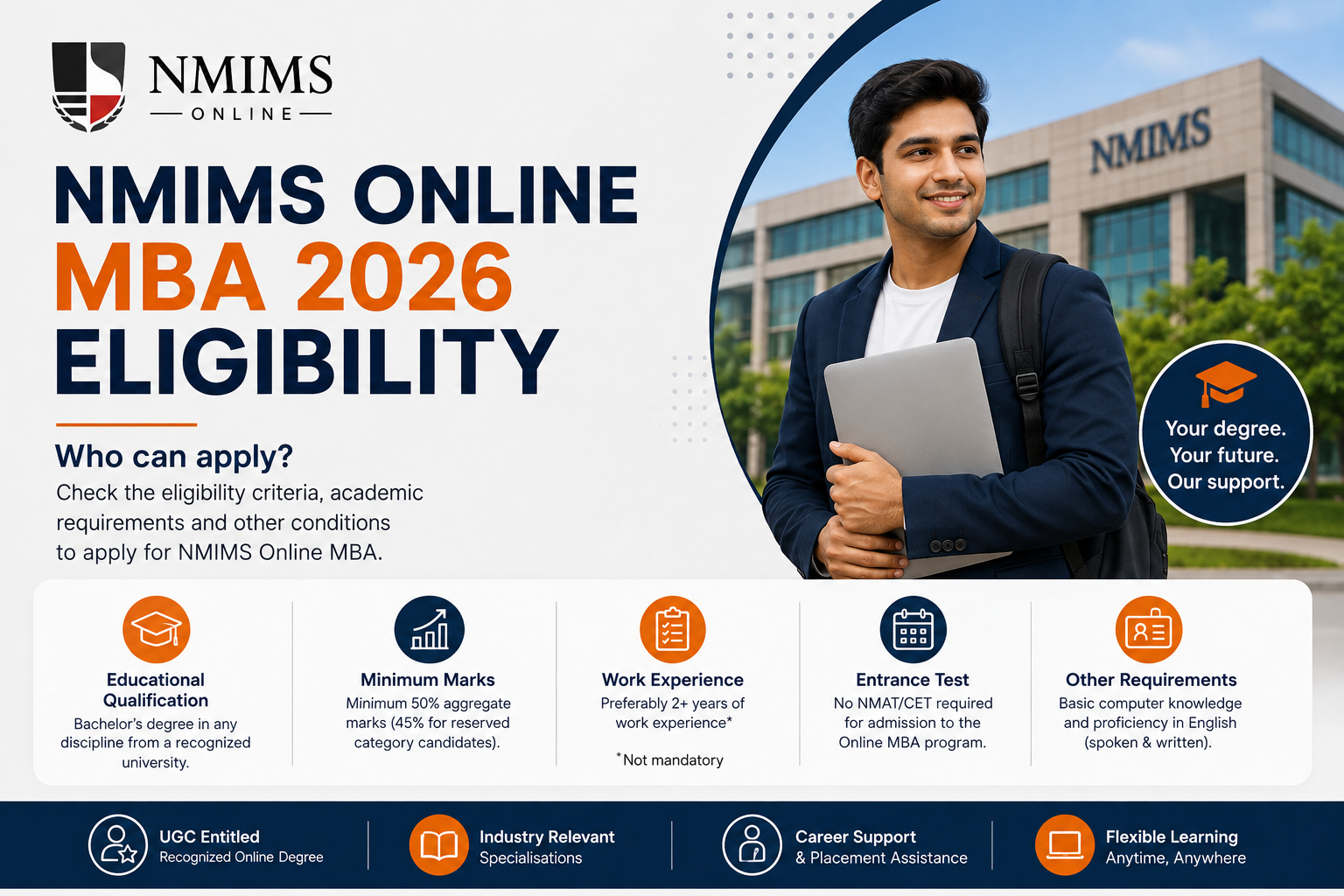
| Eligibility | Recognised graduation with 50%; 45% for SC/ST/OBC/PwD |
| Current one-time fee | ₹1,96,000, subject to change |
What Does Human Resource Management Cover?
Human Resource Management creates the conditions in which people can perform fairly and effectively. It includes hiring, but continues through role design, pay, employee relations, development, performance, change and separation.
A useful HR decision balances several interests:
- What capability does the organisation need?
- How can it attract or build that capability?
- What is fair, lawful and financially workable?
- How should performance be defined and discussed?
- What support helps people adapt to change?
- Which evidence shows whether an intervention worked?
The MBA foundation matters because people decisions affect cost, customer experience, operations and strategy. An HR professional who understands only process may struggle to influence a business decision.
Start Your Journey
Need Help Picking the Right Fee Route?
Talk to our admissions team about tuition options, complete cost and how each route affects your cash flow.
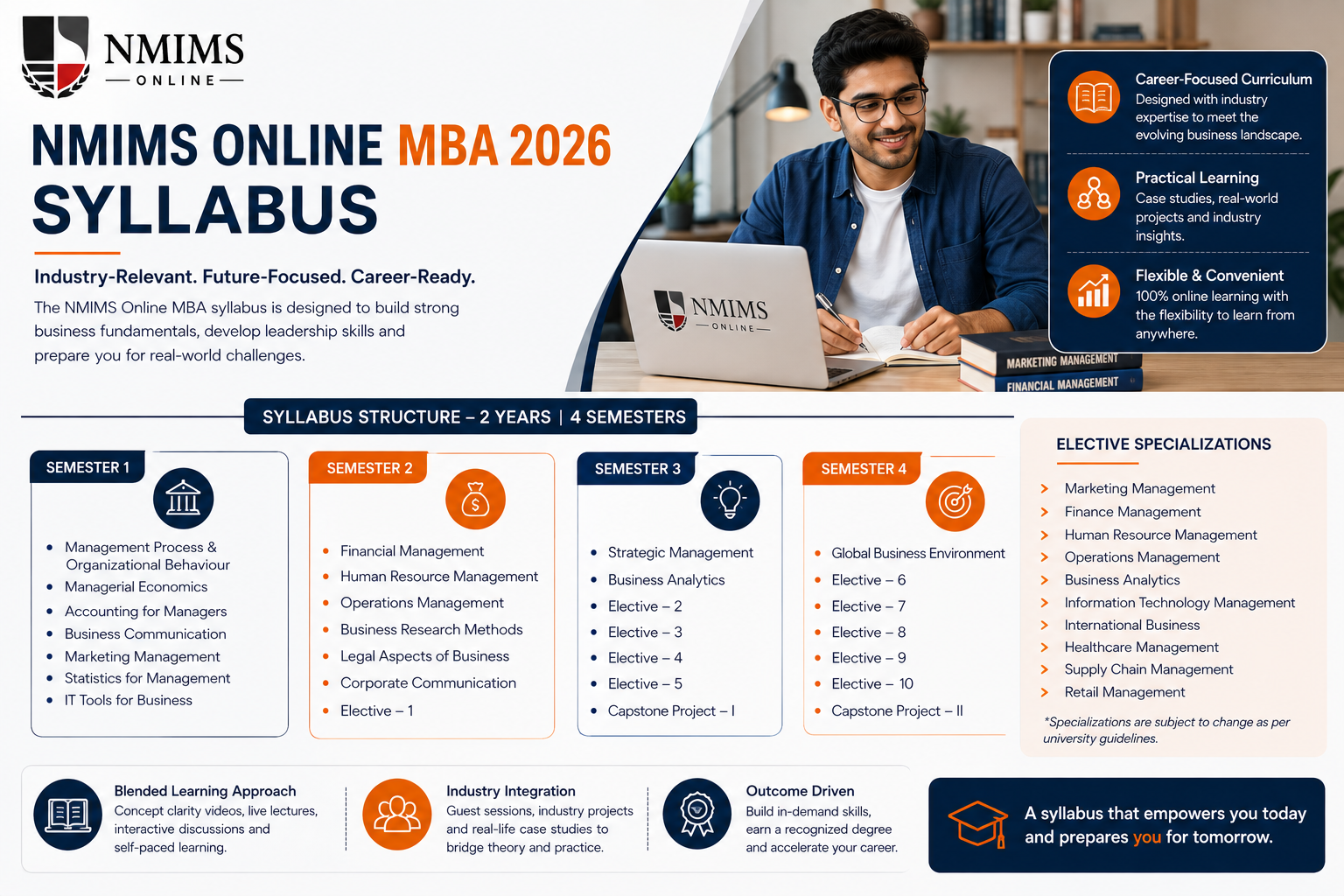
NMIMS Online MBA HR Syllabus by Semester
Semester 1: Business and behaviour foundations
- Business Communication
- Financial Accounting
- Marketing Management
- Micro Economics and Macro Economics
- Organisational Behaviour
- Quantitative Methods I
Semester 2: HR within the organisation
- Business Analytics
- Cost and Management Accounting
- Legal Aspect of Business
- Strategic Management
- Human Resource Management
- Operations Management
Semester 3: Employment systems and organisational change
The common advanced subjects include Corporate Finance, Research Methodology and project preparation. HR-specific papers listed for this semester are:
- Compensation and Benefits
- Industrial Relations and Labour Laws
- Manpower Planning, Recruitment and Selection
- Organisational Development and Change
Semester 4: Performance, capability and self-awareness
The final semester includes Corporate Sustainability, Indian Ethos and Ethics, International Business and the project, together with:
- Performance Management System
- Learning and Development
- Emotional Intelligence
What Each HR Subject Helps You Understand
Compensation and Benefits
Pay decisions must balance internal fairness, market competitiveness, affordability and performance. This subject provides a framework for reward systems. It does not replace current payroll, tax or statutory advice.
Industrial Relations and Labour Laws
This area examines the employment relationship, collective issues and legal context. Labour rules can change and may differ by location, establishment and worker category. Learners should verify current law before applying classroom principles to a real case.
Manpower Planning, Recruitment and Selection
The subject goes from workforce need to sourcing and selection. Good hiring begins with a clear capability requirement. More applications do not solve an unclear role.
Organisational Development and Change
Change succeeds through more than communication. Structure, incentives, leadership behaviour, skills and daily systems must move together. This subject can help HR professionals diagnose resistance rather than label employees as the problem.
Performance Management System
Performance management defines expectations, supports feedback and connects individual contribution with organisational goals. A rating form is only one component. The system fails when measures are unclear or managers avoid useful conversations.
Learning and Development
L&D starts with a performance or capability gap. It then asks whether training is the right intervention, how learning should be delivered and what evidence would show transfer to work.
Emotional Intelligence
Emotional intelligence can support self-awareness, listening and relationship management. It should not be used as an informal diagnosis or as a substitute for fair policy and evidence.
HR Capabilities and Portfolio Evidence
| Capability | Related subjects | Evidence you could create |
|---|---|---|
| Workforce planning | Manpower Planning, Strategy and Analytics | Demand-supply model with assumptions |
| Hiring quality | Recruitment and Selection | Structured interview and scorecard design |
| Reward thinking | Compensation and Benefits | Compensation philosophy and option analysis |
| Employee-relations judgement | Labour Laws and Ethics | Case analysis with current-law verification note |
| Change support | Organisation Development | Stakeholder and adoption plan |
| Performance alignment | Performance Management | Goal and feedback framework for a defined role |
| Capability building | Learning and Development | Needs analysis and transfer-measurement plan |
| People insight | Research Methodology and Analytics | Survey analysis that protects privacy and reports limits |
Who Should Choose the HR Specialisation?
HR generalists and operations professionals
Someone already handling employee records, onboarding or policy coordination may use the MBA to understand reward, workforce planning, performance and organisational change.
Recruiters moving toward broader HR
Recruitment experience provides one entry point. The curriculum can add context around retention, development, employee relations and performance. The learner should seek assignments beyond hiring to show this breadth.
Managers with substantial people responsibility
A line manager may choose HR to improve workforce decisions, coaching and change leadership. If the target is broader general management, Business Management may deserve comparison.
Career switchers
Switching into HR is possible, but the learner needs an entry strategy. Volunteer projects, HR operations exposure, internships, structured interviews or analytics work can show intent more credibly than the degree alone.
Consultants and founders
Small organisations often need practical systems for roles, hiring, rewards and performance. The programme can provide frameworks, while legal and payroll implementation may still require specialist advice.
HR Versus Business Management
| Decision point | Human Resource Management | Business Management |
|---|---|---|
| Main depth | Workforce and organisation systems | Cross-functional business decisions |
| Later subjects | Pay, relations, hiring, change, performance, learning, EI | Systems, customers, organisation, supply, entrepreneurship, digital and projects |
| Better fit | Defined people-function or workforce leadership path | General management or broad business coordination |
| Key project | Workforce or organisational problem | Multi-function commercial or operating problem |
Career Directions After NMIMS Online MBA HR
- HR operations
- Talent acquisition and workforce planning
- Learning and development
- Performance and reward support
- Employee relations
- Organisational development
- People analytics support
- HR business partnering
Job level depends heavily on prior experience. A two-year degree cannot compress years of employee-relations, leadership or policy responsibility into an automatic managerial title.
HR Project Ideas
- Diagnose early attrition in a defined employee group.
- Test whether a hiring scorecard improves selection consistency.
- Assess learning needs for a role affected by process change.
- Compare reward options for a small or mid-sized business.
- Evaluate manager readiness before a performance-system redesign.
- Study employee experience during onboarding.
- Analyse adoption barriers in an organisational change initiative.
- Build a workforce-planning model for a seasonal operation.
Practical Skills to Add Outside the Curriculum
Role requirements may include tools or practices that a subject title does not confirm. Depending on your target, build ability in:
- Spreadsheet analysis and simple dashboards
- HRIS or applicant-tracking workflows
- Structured interviewing
- Policy writing in plain language
- Survey design and interpretation
- Basic employment-data privacy
- Facilitation and difficult conversations
- Current labour-law research
Eligibility, Fees and Study Format
Applicants currently need a bachelor’s degree under 10+2+3 from a recognised university, or an equivalent recognised by AIU, with at least 50% marks and 45% for SC, ST, OBC and PwD applicants.
NMIMS currently lists three tuition routes: ₹1,96,000 one-time, ₹1,05,000 annually or ₹55,000 per semester. Separate published charges include ₹1,200 for admission processing, ₹800 per examination subject per attempt and ₹800 per project attempt. Always recheck.
Learning uses live and recorded lectures, Student Zone courseware, e-books, journals and transcripts. Assessment includes IA and TEE. Working professionals should request the current schedule before assuming that every live session fits their office hours.
Is NMIMS Online MBA HR Worth It?
Yes, the NMIMS Online MBA in Human Resource Management can be worth it for working professionals and aspiring HR professionals who want to strengthen their understanding of talent management, employee development, organizational behaviour, and strategic human resource practices. The flexible online format allows learners to continue working while developing relevant management and HR skills. However, whether the program is worth it depends on your career goals, existing work experience, budget, and expected career outcomes. Before enrolling, review the curriculum, specialization subjects, fees, learning format, and career support to determine whether the program aligns with your long-term professional goals.
Conclusion
NMIMS Online MBA Human Resource Management takes learners beyond recruitment into pay, employee relations, workforce planning, organisational change, performance and development. It can support an HR or people-leadership path when the learner also builds practical, ethical evidence. Verify the active syllabus, keep legal knowledge current and choose the specialisation because it matches the workforce problems you want to solve—not because HR appears easier than other MBA tracks.
Frequently Asked Questions
The seven specialist subjects cover compensation, industrial relations and labour laws, workforce planning and hiring, organisational change, performance, learning and emotional intelligence.