Table of Content
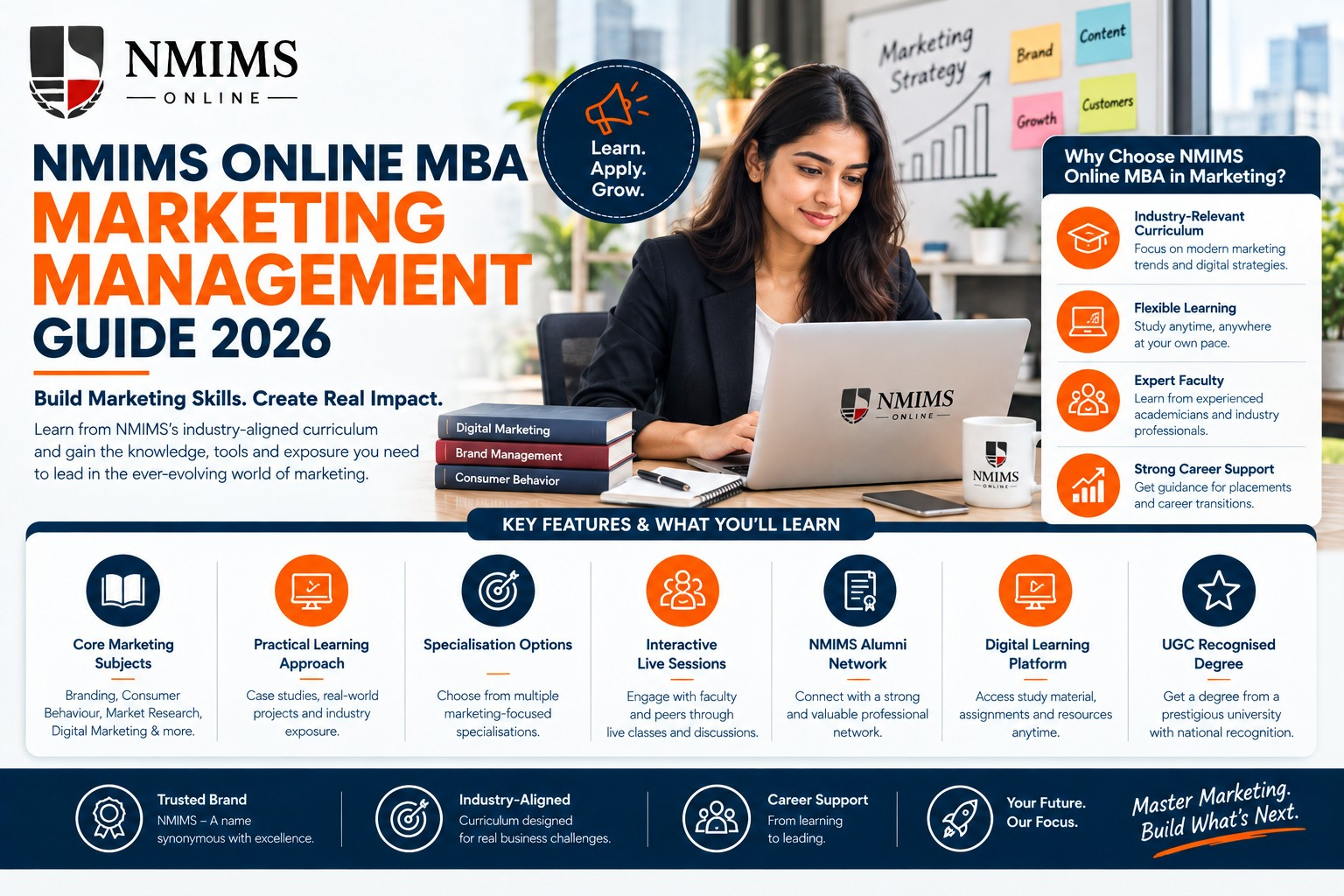
The NMIMS Online MBA in Marketing Management combines a general management foundation with seven marketing subjects: Brand Management, Consumer Behaviour, Integrated Marketing Communications, Sales Management, International Marketing, Services Marketing and Digital Marketing. It is best examined by learners who want to understand customers, markets, brands, sales and growth decisions—not only social media promotion.
The programme currently lasts two years across four semesters and has a four-year completion-validity window. Learning includes live and recorded lectures, digital resources and formal evaluation through internal assessment and term-end examination.
NMIMS Online MBA Marketing Management at a Glance
| Feature | Current published detail |
|---|---|
| Programme | MBA Online—Marketing Management |
| Duration | 2 years |
| Academic structure | 4 semesters |
| Completion validity | 4 years |
| Evaluation | Internal assessment plus term-end examination |
| Total curriculum | 102 credits on the detailed programme reference |
| Specialisation subjects | 7 Marketing papers |
| Learning format | Live and recorded online learning with digital course resources |
| Eligibility | Recognised bachelor’s degree with 50%; 45% for SC/ST/OBC/PwD |
| Current one-time fee | ₹1,96,000, subject to change |
What Does the Marketing Specialisation Actually Cover?
Marketing is the process of understanding a market, choosing whom to serve, shaping an offer, communicating its value and building a route to revenue. Promotion is only one part of that system.
The NMIMS curriculum reflects this wider view. Brand Management and Consumer Behaviour address how people perceive and choose. Sales Management covers the organisation that converts opportunity into revenue. Integrated Marketing Communications connects messages across channels. International and Services Marketing introduce contexts where customer expectations and market conditions differ. Digital Marketing examines online routes to attention, engagement and response.
Because the programme is an MBA, learners also study finance, operations, analytics, strategy, law and people management. This matters: a marketing decision is only useful when the business can fund, deliver and measure it.
Semester-Wise NMIMS Online MBA Marketing Syllabus
Semester 1: Learn the language of business
- Business Communication
- Financial Accounting
- Marketing Management
- Micro Economics and Macro Economics
- Organisational Behaviour
- Quantitative Methods I
The first semester builds the base for credible marketing decisions. Accounting helps a marketer understand the financial effect of acquisition and pricing choices. Economics adds demand and competitive context. Quantitative methods support evidence-based reasoning.
Semester 2: Connect marketing to execution
- Business Analytics
- Cost and Management Accounting
- Legal Aspect of Business
- Strategic Management
- Human Resource Management
- Operations Management
A campaign does not run in isolation. It depends on data, budget, legal boundaries, team capability, channel operations and a wider strategy. Semester two shows these connections.
Semester 3: Brand, buyer and sales system
Common subjects include Corporate Finance and Research Methodology, along with project preparation. The Marketing papers listed for this stage are:
- Brand Management
- Consumer Behaviour
- Integrated Marketing Communications
- Sales Management
Semester 4: Market expansion and digital channels
Common papers include Corporate Sustainability, Indian Ethos and Ethics, International Business and the project. Marketing study continues through:
- International Marketing
- Services Marketing
- Digital Marketing
The detailed curriculum reference assigns four credits to each regular subject and six credits to the project, producing 102 programme credits overall
What You Learn From Each Marketing Subject
Brand Management
Brand Management examines how a business builds meaning, recognition and preference over time. A learner should come away able to discuss positioning, brand consistency and the relationship between promise and customer experience.
The practical question is not “How do we make the logo more visible?” It is “What should customers associate with this offer, and what evidence reinforces that association?”
Consumer Behaviour
This subject focuses on how individuals and groups recognise needs, evaluate options and make choices. It can support customer research, segmentation, messaging and experience design.
A strong learner does not use consumer psychology to invent stereotypes. They form a hypothesis, gather evidence and remain open to behaviour that contradicts the assumption.
Integrated Marketing Communications
Integrated communication aims to make advertising, content, sales material, public relations and direct communication work together. The skill is message coordination across the customer journey, not publishing the same sentence everywhere.
Sales Management
Sales Management adds structure to territories, targets, pipelines, teams and performance. It helps connect a marketing promise with the conversations and processes that convert demand into revenue.
International Marketing
Entering another market requires more than translation. Demand, regulation, channels, competition, culture and pricing can differ. This subject helps learners consider where a standard approach works and where adaptation is necessary.
Services Marketing
Services are experienced as they are delivered. People, process, trust and consistency therefore matter alongside promotion. This area is relevant to education, healthcare, finance, hospitality, consulting, SaaS and other service businesses.
Digital Marketing
Digital Marketing covers the online side of reaching and engaging customers. The subject title does not prove that a particular advertising, analytics or automation platform is taught. Applicants who need tool proficiency should request the active module outline and plan separate hands-on practice.
Skills and Evidence You Can Build
| Skill area | Curriculum connection | Useful evidence |
|---|---|---|
| Customer insight | Consumer Behaviour and Research Methodology | Interview or survey analysis with clear limitations |
| Brand thinking | Brand Management | Positioning brief and brand-consistency audit |
| Campaign planning | Integrated Communications and Digital Marketing | Channel plan tied to one audience and objective |
| Sales alignment | Sales Management | Funnel diagnosis or territory decision framework |
| Market expansion | International Marketing | Entry-screening model for a selected market |
| Service growth | Services Marketing | Customer journey and service-recovery proposal |
| Commercial judgement | Finance, accounting and strategy | Campaign business case with cost and expected impact |
| Measurement | Analytics and quantitative methods | KPI plan that distinguishes activity from outcome |
Who Should Consider This Specialisation?
Marketing and content professionals seeking wider responsibility
Someone already running content, social or performance campaigns may need stronger brand, research, sales and commercial context before moving into a management role.
Sales professionals moving toward revenue leadership
The combination of customer behaviour, communication and sales management can help a salesperson see beyond individual deals. However, the degree does not replace a track record of pipeline ownership and target delivery.
Product and customer-experience professionals
These roles often require insight into customer needs, positioning, adoption and service experience. Marketing may fit when the work is customer-led rather than primarily technical.
Entrepreneurs
Founders must choose a market, define value, acquire customers and manage sales. The curriculum can give these decisions structure. The founder still needs to test assumptions in the real market.
Career switchers
Marketing can support a switch when coursework is paired with evidence. A learner should build projects, gain adjacent experience and explain how existing skills transfer. The MBA title alone will not erase a missing portfolio.
When Another Specialisation May Fit Better
| Main goal | Specialisation to compare |
|---|---|
| Broad cross-functional leadership | Business Management |
| Valuation, investments or financial decision-making | Finance Management |
| Workforce, employee relations or talent systems | Human Resources Management |
| Supply, process, quality and operational analytics | Operations and Data Sciences |
| Analytics across several business domains | Business Analytics |
| Technology management and digital systems | Information Technology Management |
Career Directions After an Online MBA in Marketing
- Brand and category support
- Digital marketing and growth operations
- Sales enablement and revenue operations
- Market research and customer insight
- Product marketing
- Services marketing and customer experience
- Account or channel management
Marketing Project Ideas
- Test whether a brand’s current positioning matches customer language.
- Compare acquisition channels using cost, lead quality and conversion evidence.
- Design a service-recovery framework for a high-friction customer journey.
- Assess a regional market for product expansion.
- Diagnose sales-pipeline leakage and recommend process changes.
- Develop an integrated launch plan for a new service.
- Study factors influencing repeat purchase in a selected category.
- Evaluate how digital communication supports or weakens a brand promise.
What the MBA May Not Teach Deeply Enough
An MBA provides management frameworks. Many marketing roles also require tool-level execution. Depending on your target, you may need separate practice in:
- Web and campaign analytics
- Advertising-platform operation
- Marketing automation and CRM workflows
- Search and content research
- Spreadsheet analysis and dashboarding
- Customer interviews and usability research
- Copy, creative briefing or experimentation
Eligibility, Fees and Learning Format
The current academic requirement is a recognised bachelor’s degree under the 10+2+3 pattern, or an AIU-recognised equivalent, with at least 50% marks. NMIMS lists 45% for SC, ST, OBC and PwD applicants. Work experience is not currently compulsory for MBA Online.
NMIMS Online MBA Fee Structure
| Fee Component | Amount |
|---|---|
| One-time program fee | ₹1,96,000 |
| Annual payment | ₹1,05,000 per year |
| Semester-wise payment | ₹55,000 per semester |
| Processing fee | ₹1,200 |
| Examination fee | ₹800 per subject per attempt |
| Project fee | ₹800 per attempt |
The learning experience includes live and recorded lectures, Student Zone access, e-books, journals, transcripts and learner support. Flexibility does not remove assessments or examination deadlines.
Is NMIMS Online MBA Marketing Worth It?
Yes, the NMIMS Online MBA in Marketing can be worth it for working professionals and aspiring marketers who want to strengthen their knowledge of marketing strategy, consumer behavior, branding, and digital business. The online format allows learners to continue working while developing relevant management and marketing skills.
However, the value of the program depends on your career goals, current work experience, budget, and expectations. Before enrolling, review the curriculum, specialization subjects, fees, learning format, and career support to determine whether the program aligns with your professional goals.
Conclusion
NMIMS Online MBA Marketing Management offers a broad view of how organisations understand customers and create demand. Its seven papers move from brand and buyer insight to sales, services, international markets and digital channels. Choose it when that complete marketing system supports your next role—not simply because digital marketing is popular. Verify the active syllabus, add hands-on evidence and judge the degree through outcomes you can realistically influence.
Frequently Asked Questions
The seven specialisation subjects are Brand Management, Consumer Behaviour, Integrated Marketing Communications, Sales Management, International Marketing, Services Marketing and Digital Marketing.