Table of Content
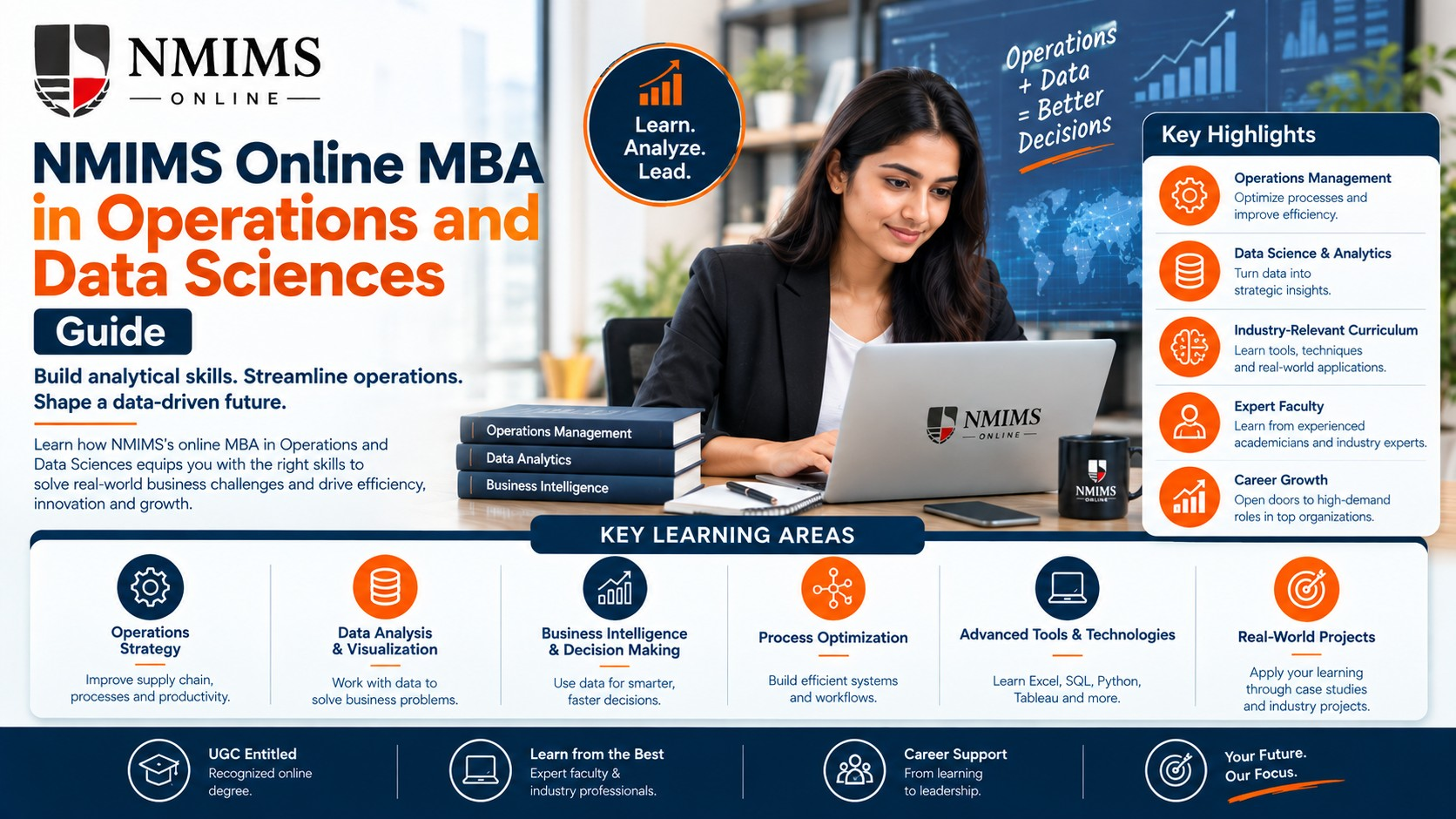
The NMIMS Online MBA in Operations and Data Sciences Management combines process, project, supply-chain and quality decisions with IoT, big-data context, exploratory analysis, visualisation and operations analytics. It is aimed at management application: using evidence to improve flow, sourcing, delivery and quality. It should not be mistaken for a pure data-science or software-engineering degree.
The current subject includes Project Management, Strategic Applications of IoT and Big Data, Strategic Sourcing and E-procurement, Supply Chain Management, EDA and Data Visualization, Operations Analytics and Total Quality Management.
Programme Overview
| Feature | Current published detail |
|---|---|
| Programme | MBA Online—Operations and Data Sciences Management |
| Duration | 2 years |
| Structure | 4 semesters |
| Completion validity | 4 years |
| Evaluation | Internal assessment plus term-end examination |
| Published total | 102 credits in the detailed MBA curriculum structure |
| Specialist papers | 7 operations/data-focused subjects |
| Delivery | Online learning with live sessions, recordings and digital resources |
| Eligibility | Graduation with 50%; 45% for SC/ST/OBC/PwD |
| Current one-time fee | ₹1,96,000, subject to change |
What Does “Operations and Data Sciences” Mean?
Operations and Data Sciences is an interdisciplinary field that combines business operations, analytical thinking, and data-driven decision-making. It focuses on using data, technology, and analytical methods to improve how organizations plan, manage, and execute their day-to-day activities.
Operations involve managing processes such as production, supply chains, logistics, resource allocation, quality control, and service delivery. Data Science, on the other hand, involves collecting, analyzing, and interpreting data to identify patterns, solve problems, and support better business decisions.
Start Your Journey
Interested in NMIMS Online MBA Operations and Data Sciences?
Talk to our admissions team about the programme, eligibility, fees and learning format.
Semester-Wise Syllabus
Semester 1: Business and Quantitative Foundations
- Business Communication
- Financial Accounting
- Marketing Management
- Micro Economics and Macro Economics
- Organisational Behaviour
- Quantitative Methods I
Semester 2: Core Management and Operations
- Business Analytics
- Cost and Management Accounting
- Legal Aspect of Business
- Strategic Management
- Human Resource Management
- Operations Management
Semester 3: Projects, Connected Operations and Supply
- Corporate Finance
- Research Methodology
- Project pre-work
- Project Management
- Strategic Applications of IoT and Big Data
- Strategic Sourcing and E-procurement
- Supply Chain Management
Semester 4: Analysis, Visualisation and Quality
- Corporate Sustainability
- Indian Ethos and Ethics
- International Business
- Project
- EDA and Data Visualization
- Operations Analytics
- Total Quality Management
What the Seven Specialist Subjects Contribute
Project Management
Project Management provides a structure for scope, schedule, resources, risk and stakeholder coordination. Operations work often becomes a project when a new process, facility, system or improvement is introduced.
Strategic Applications of IoT and Big Data
This subject examines how connected devices and large data flows can influence management. Examples may include asset monitoring, inventory visibility or maintenance signals. The managerial challenge is to separate a useful business case from technology added without a clear problem.
Strategic Sourcing and E-procurement
Procurement decisions influence cost, quality, continuity and risk. Strategic sourcing considers total value and supplier capability. E-procurement adds systems, data and workflow to the purchasing process.
Supply Chain Management
Supply chains connect suppliers, operations, inventory, logistics and customers. The subject can help learners examine end-to-end flow rather than optimise one department while creating problems elsewhere.
EDA and Data Visualization
Exploratory data analysis helps a learner inspect a dataset before making strong claims. Visualisation should reveal distribution, variation, relationships or exceptions—not decorate a conclusion already chosen.
Operations Analytics
Operations analytics applies data to questions in demand, inventory, scheduling, capacity, delivery and process performance. Applicants should ask which methods and tools are included in the active module.
Total Quality Management
TQM views quality as an organisation-wide system. It connects customer requirements, process consistency, leadership, measurement and continuous improvement. The goal is not only detecting defects at the end.
Management Skills Versus Technical Skills
This specialisation sits between two skill sets.
| Management capability | Analytical or technical complement |
|---|---|
| Define an operating problem | Clean and inspect relevant data |
| Select process measures | Calculate and visualise performance |
| Compare supplier or capacity options | Build a transparent decision model |
| Coordinate improvement work | Track milestones, risks and outcomes |
| Explain a recommendation | Present uncertainty and assumptions clearly |
| Design quality controls | Monitor variation and exceptions |
Who Should Consider This Specialisation?
Operations and Process Professionals
People already responsible for service delivery, production, capacity or workflow can use the analytical subjects to make improvement decisions more evidence-based.
Supply-Chain, Logistics and Procurement Professionals
The combination of sourcing, supply chain and analytics aligns with roles where cost, availability and service must be balanced. Experience with suppliers or planning gives the course concepts immediate context.
Engineers Moving Toward Management
Engineers often bring process and problem-solving discipline. The MBA adds finance, people, market and strategy context needed for broader responsibility.
Project Coordinators
Project Management can strengthen delivery structure, while the wider curriculum adds operations and data context. Someone seeking formal project certification should compare that separate path.
Analysts Interested in an Operating Domain
A data or business analyst may choose this route to build subject-matter depth in operations. They should still examine whether Business Analytics provides a wider match for their target roles.
Operations and Data Sciences Versus Business Analytics
| Decision point | Operations and Data Sciences | Business Analytics |
|---|---|---|
| Main domain | Process, supply, sourcing, projects and quality | Data-supported decisions across multiple business areas |
| Data subjects | IoT/Big Data applications, EDA, Operations Analytics | Data analytics, machine learning for managers, visual and consumer analytics |
| Strongest fit | Operations, supply chain, procurement, quality and delivery | Business analyst, analytics translator and cross-domain decision roles |
| Project context | Operational performance problem | Business question that may come from several functions |
Capabilities and Portfolio Evidence
| Target capability | Possible evidence |
|---|---|
| Process diagnosis | Current-state map with time, handoff and defect evidence |
| Inventory judgement | Service-versus-stock trade-off analysis |
| Supplier evaluation | Weighted scorecard with cost, quality and risk |
| Project delivery | Scope, dependency, risk and benefit plan |
| Operational insight | Dashboard that answers a defined decision question |
| Quality improvement | Root-cause study and controlled improvement proposal |
| Data communication | Visual narrative that includes exceptions and limitations |
Eligibility, Fees and Learning Format
Current eligibility is a recognised 10+2+3 bachelor’s degree or AIU-recognised equivalent with at least 50% marks, and 45% for SC, ST, OBC and PwD candidates. Work experience is not compulsory for MBA Online.
The fee is ₹1,96,000 for full payment, ₹1,05,000 annually or ₹55,000 per semester. Separate charges include ₹1,200 admission processing, ₹800 per subject per examination attempt and ₹800 per project attempt. Recheck all amounts.
Learning resources include live and recorded lectures, Student Zone access, e-books, journals and transcripts. Evaluation is shown as IA + TEE. The online format still contains deadlines and examination preparation.
Conclusion
NMIMS Online MBA Operations and Data Sciences Management brings analytical thinking into the operating core of a business. The subjects connect projects, IoT, sourcing, supply chains, exploratory analysis, operations analytics and quality. It is a management specialization, not a shortcut to a technical data-science title. Verify the active curriculum and tool coverage, then choose it if operational problems—not the popularity of data—match your next step.
Frequently Asked Questions
Subjects that are included in NMIMS Operations and Data Sciences are Project Management, IoT and Big Data applications, sourcing and e-procurement, Supply Chain, EDA and visualisation, Operations Analytics and Total Quality Management.