Table of Content
The seven current NMIMS Online MBA specializations are Business Management, Marketing Management, Finance Management, Human Resources Management, Operations and Data Sciences, Information Technology Management and Business Analytics. The right choice depends on the business problems you want to solve, not which option sounds most popular.
Every learner first develops a common management foundation. The specialization becomes more important in the later semesters through electives and project work.
NMIMS Online MBA Specializations at a Glance
| Specialization | Main decision area | May fit learners interested in |
|---|---|---|
| Business Management | Cross-functional business performance | General management, entrepreneurship, growth and coordination |
| Marketing Management | Customers, markets and revenue growth | Brand, sales, customer insight, digital marketing and go-to-market |
| Finance Management | Financial performance and capital | Corporate finance, planning, analysis, risk and financial decision-making |
| Human Resources Management | People and organisation | Talent, performance, employee relations and organisational development |
| Operations and Data Sciences | Process, supply and operating evidence | Operations, supply chain, quality, capacity and data-informed improvement |
| Information Technology Management | Technology value, delivery and risk | IT projects, digital transformation, governance, product and technology operations |
| Business Analytics | Data-backed management decisions | Analysis, visualisation, modelling, insight and stakeholder communication |
How the NMIMS Online MBA Curriculum Is Organised
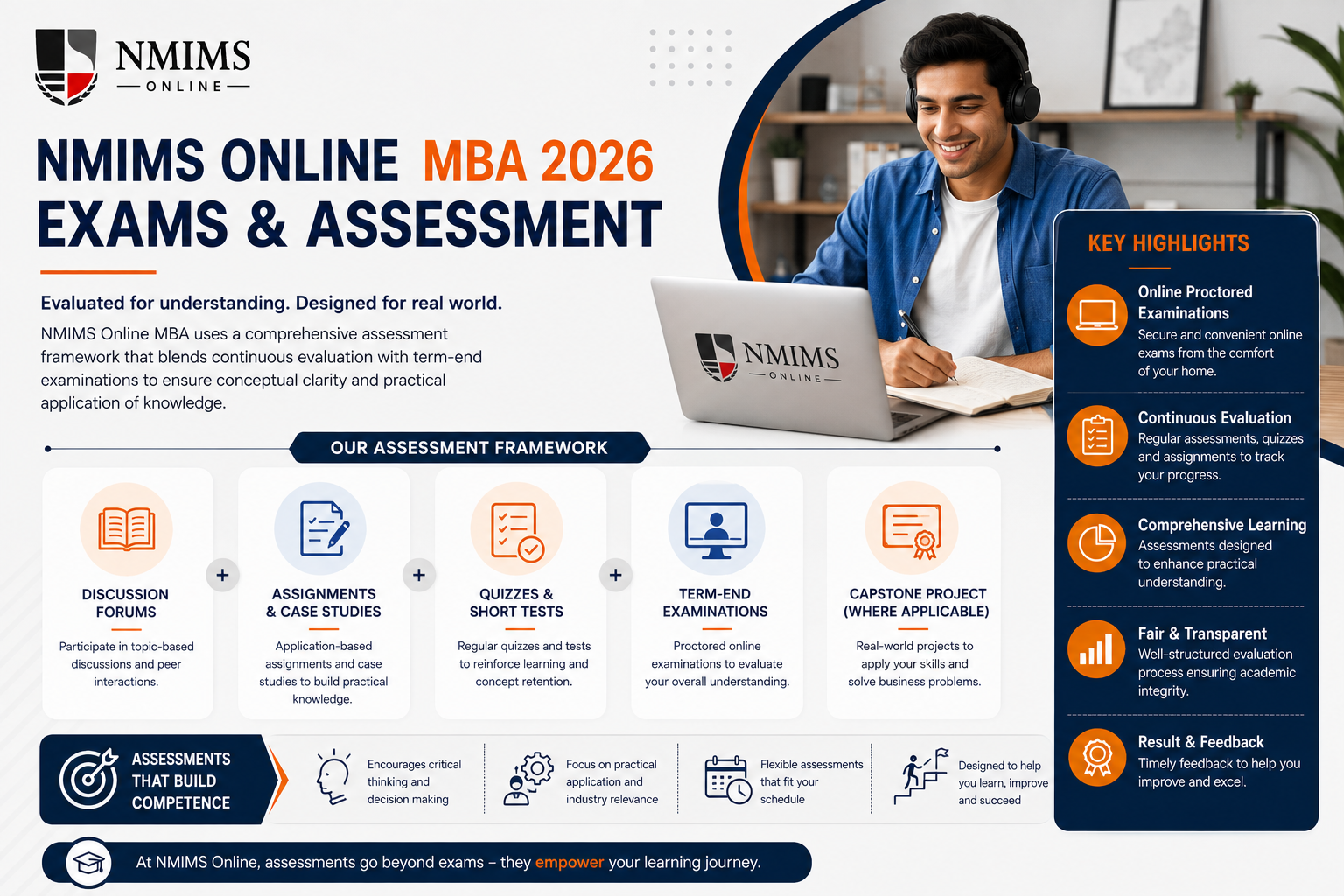
NMIMS MBA Online runs as a two-year programme with four semesters and a four-year validity period. Evaluation is presented as Internal Assessment plus Term-End Examination. A project is included in the later stage.
Semester 1: Core business language
The current programme pages list:
- Business Communication
- Financial Accounting
- Marketing Management
- Micro Economics and Macro Economics
- Organisational Behaviour
- Quantitative Methods – I
Semester 2: Management integration
The current list includes:
- Business Analytics
- Cost and Management Accounting
- Legal Aspect of Business
- Strategic Management
- Human Resource Management
- Operations Management
Semesters 3 and 4: Specialization and application
The lists include Corporate Finance and Research Methodology before elective subjects. The fourth semester includes Corporate Sustainability, Indian Ethos and Ethics, International Business, additional electives and a project.
The shared foundation means the specialization does not make the degree one-dimensional. A Finance learner still studies people and marketing. An HR learner still encounters accounting and operations. The choice changes the area of deeper attention.
Start Your Journey
Not Sure Which Specialization Fits You?
Talk to our admissions team about the seven specializations, elective structure and how each option maps to your background.
1. Business Management
Business Management is the broadest of the seven directions. It is a way to deepen core management concepts and combine management practices with marketing, economics, accounting and finance to solve business problems.
What the specialization is really about
It focuses on seeing the organisation as a connected system. A general manager cannot improve sales without considering delivery capacity, cash flow and people. A founder cannot plan expansion without testing market demand, cost and execution risk.
Skills to develop
- Cross-functional problem framing
- Business-model and growth analysis
- Financial interpretation for managers
- Stakeholder communication
- Strategy execution
- Team and resource coordination
- Decision-making under competing priorities
Who may find it useful
- Professionals moving toward broader responsibility
- Founders and family-business professionals
- Functional specialists who need enterprise-wide understanding
- Learners who have not yet chosen one narrow function
Who should think twice
If you already know that your goal requires deeper finance, HR, analytics or technology learning, a focused option may make the story clearer.
Practical project direction
Evaluate one growth decision across customer demand, financial viability, operating capacity and organisational readiness.
2. Marketing Management
The Marketing specialization is for learners interested in how organisations understand customers, create value, communicate it and turn demand into sustainable revenue.
What the specialization is really about
Marketing is not limited to advertising or social media. It covers segmentation, positioning, product decisions, pricing, sales, distribution, customer experience and measurement.
Skills to develop
- Customer and market research
- Segmentation and targeting
- Brand positioning
- Go-to-market planning
- Campaign measurement
- Sales and channel understanding
- Customer retention analysis
Who may find it useful
- Marketing, sales or customer-experience professionals
- Founders responsible for customer growth
- Professionals moving from delivery into market-facing work
- Learners who enjoy combining creativity with evidence
Who should think twice
It may be a poor choice if you dislike customer research, commercial measurement and repeated testing. Marketing is not simply idea generation.
Practical project direction
Diagnose one stage of a company's customer journey, identify evidence behind the problem and recommend a measurable change.
3. Finance Management
Finance Management focuses on how organisations measure performance, allocate capital, manage financial risk and evaluate decisions.
Accounting, financial strategies, risk assessment and capital investment require comfort with numbers, but the larger goal is judgement rather than formula memorisation.
What the specialization is really about
Finance helps answer questions such as:
- Is a project likely to create value?
- Can the organisation fund it safely?
- Which performance issue needs attention?
- How sensitive is the decision to changing assumptions?
- What financial control protects the business?
Skills to develop
- Financial statement interpretation
- Budgeting and management analysis
- Investment and capital evaluation
- Risk thinking
- Valuation logic
- Financial communication for non-finance stakeholders
- Assumption and scenario analysis
Who may find it useful
- Accounting and finance professionals seeking broader management depth
- Analysts who want stronger commercial context
- Entrepreneurs who need better financial control
- Managers responsible for budgets or investment cases
Who should think twice
Do not choose Finance only because it sounds prestigious or high-paying. The work needs consistent quantitative practice and careful interpretation.
Practical project direction
Use public financial information to analyse a company's performance, identify one issue and test alternative scenarios without presenting a forecast as fact.
4. Human Resources Management
Human Resources Management centres on the relationship between organisational needs and the people who perform the work.
What the specialization is really about
HR is not only recruitment and employee events. It includes workforce planning, role design, selection, onboarding, performance, rewards, learning, employee relations, policy and change.
Skills to develop
- Workforce planning
- Talent acquisition and selection
- Performance and feedback systems
- Learning and capability development
- Employee relations
- HR policy interpretation
- Organisational change and communication
Who may find it useful
- HR professionals seeking stronger business understanding
- Team leaders moving toward people operations
- Recruiters who want broader employee-lifecycle knowledge
- Professionals interested in organisational development
Who should think twice
The specialization may not fit someone who wants only interpersonal work. HR also involves evidence, policy, difficult decisions, documentation and business trade-offs.
Practical project direction
Study an onboarding, retention or skill-gap issue using anonymised evidence and propose an intervention with clear success measures.
5. Operations and Data Sciences
Operations and Data Sciences combines the management of processes and resources with evidence used to improve them. It refers to production, performance, cost, supply networks, service operations and manufacturing operations.
What the specialization is really about
Operations focuses on how work flows from demand to delivery. Data helps identify bottlenecks, variability, quality issues and the effect of a proposed change.
Skills to develop
- Process mapping
- Capacity and resource planning
- Supply-chain thinking
- Inventory and service-level trade-offs
- Quality improvement
- Operational measurement
- Root-cause analysis
- Data-informed decision-making
Who may find it useful
- Professionals in manufacturing, logistics, supply chain or service delivery
- Engineers moving toward business operations
- Analysts working with operational performance
- Managers responsible for cost, quality or turnaround time
Who should think twice
The route may not suit someone seeking analytics without interest in operating systems and process implementation. It is not merely a software course.
Practical project direction
Map a real process, establish a baseline, identify one bottleneck and propose an improvement with a measurable operating result.
6. Information Technology Management
Information Technology Management sits between business needs and technology delivery. It may suit learners who want to manage technology-enabled change rather than work only at the coding or infrastructure level.
What the specialization is really about
Technology decisions involve cost, value, delivery, risk, people and adoption. A technically correct system can still fail if the business case is weak, stakeholders are not aligned or the change is poorly adopted.
Skills to develop
- Technology-business alignment
- Project and product coordination
- Digital-transformation planning
- Technology risk and compliance awareness
- Vendor and service management
- Agile delivery understanding
- Change adoption
- Benefits measurement
Who may find it useful
- IT professionals moving toward management
- Engineers interested in product or programme leadership
- Business professionals coordinating digital initiatives
- Operations leaders responsible for enterprise systems
Who should think twice
This is a management specialization, not a substitute for deep technical training in programming, cloud engineering or cybersecurity operations.
Practical project direction
Build a business case for one technology initiative covering user problem, expected benefit, delivery risk, adoption and measurement.
7. Business Analytics
Business Analytics focuses on turning data into decisions. It is appropriate for learners who want to frame business questions, examine evidence and explain recommendations to stakeholders.
Analytics-related elective titles include Data Analytics for Business, Machine Learning for Managers, Business Process Modelling and Management, Visual Analytics, Operational and Supply Chain Analytics and Consumer Data Analytics. Because the same elective list appears across several live specialization pages, verify the correct option-specific mapping in the current brochure.
What the specialization is really about
Analytics begins before a dashboard. The learner needs to define the decision, understand the data, choose a reasonable method and communicate uncertainty.
Skills to develop
- Business-question framing
- Data-quality assessment
- Descriptive and diagnostic analysis
- Visual communication
- Model interpretation
- Stakeholder storytelling
- Ethical use of data
- Measurement of business impact
Who may find it useful
- Analysts who want more business context
- Managers who work with dashboards and performance data
- Commerce or engineering graduates interested in decision support
- Professionals moving toward data-informed product, marketing or operations work
Who should think twice
Choose carefully if your main goal is to become a specialist data engineer or research-level data scientist. An MBA specialization emphasises management application and does not replace deep technical training.
Practical project direction
Take one commercial or operational question from definition to dataset review, analysis, recommendation and success metric.
Which NMIMS Online MBA Specialization Is Best for You?
1. Start with the target work
Do not begin with the course title. Collect three job descriptions or describe the business responsibility you want. Identify the repeated tasks.
2. Identify transferable strengths
An engineer may already bring systems thinking. A B.Com graduate may bring accounting knowledge. A recruiter may understand hiring but need stronger workforce-planning depth.
The specialization should add to these strengths, not simply repeat them.
3. Find the largest capability gap
| Current background | Possible gap | Options worth examining |
|---|---|---|
| Engineering or IT | Commercial and leadership breadth | IT Management, Operations, Analytics, Business Management |
| Commerce or accounting | Data, market or broader management depth | Finance, Analytics, Marketing, Business Management |
| Sales or marketing | Financial, analytical or cross-functional depth | Marketing, Analytics, Business Management |
| HR or recruitment | Business alignment and organisation depth | Human Resources, Business Management |
| Operations or supply chain | Analytics and enterprise decision-making | Operations and Data Sciences, Business Analytics |
| Entrepreneur | Cross-functional control and growth | Business Management, Marketing, Finance, Operations |
4. Test the project potential
Ask: “Can I name a problem I would like to study in this field?” A clear project direction often shows that the interest is practical rather than temporary.
Specialization Comparison by Career Direction
| Career direction | Strong options to investigate | Important caution |
|---|---|---|
| General management | Business Management | Breadth still needs practical responsibility |
| Brand, growth or sales | Marketing Management | Marketing is analytical as well as creative |
| Financial analysis or planning | Finance Management | The degree alone does not confer regulated credentials |
| Talent or people operations | Human Resources Management | HR roles still require policy and business understanding |
| Supply chain or process improvement | Operations and Data Sciences | Tools matter only when applied to operating problems |
| Technology leadership | Information Technology Management | Management study does not replace technical competence |
| Business decision support | Business Analytics | Analytics is broader than software usage |
Questions to Ask Before Selecting
- Which exact electives apply to this specialization in the active intake?
- Are all listed electives compulsory or is there a choice?
- In which semester does specialization learning begin?
- What is the project format?
- Can the project use a workplace problem?
- Are there confidentiality restrictions for workplace information?
- What tools or prior quantitative knowledge are useful?
- Can the specialization be changed after admission?
- If a change is allowed, what deadline and fee apply?
- Which career-service modules are available to this programme?
Conclusion
The best NMIMS Online MBA specialization is the one you can connect to specific work, a genuine capability gap and a useful project. Business Management offers breadth. Marketing, Finance and HR provide functional directions. Operations and Data Sciences, IT Management and Business Analytics address different forms of process, technology and evidence-led decision-making. Review the active elective list before applying, especially where the live pages appear inconsistent.
Frequently Asked Questions
The MBA hub currently has seven specializations.