Table of Content
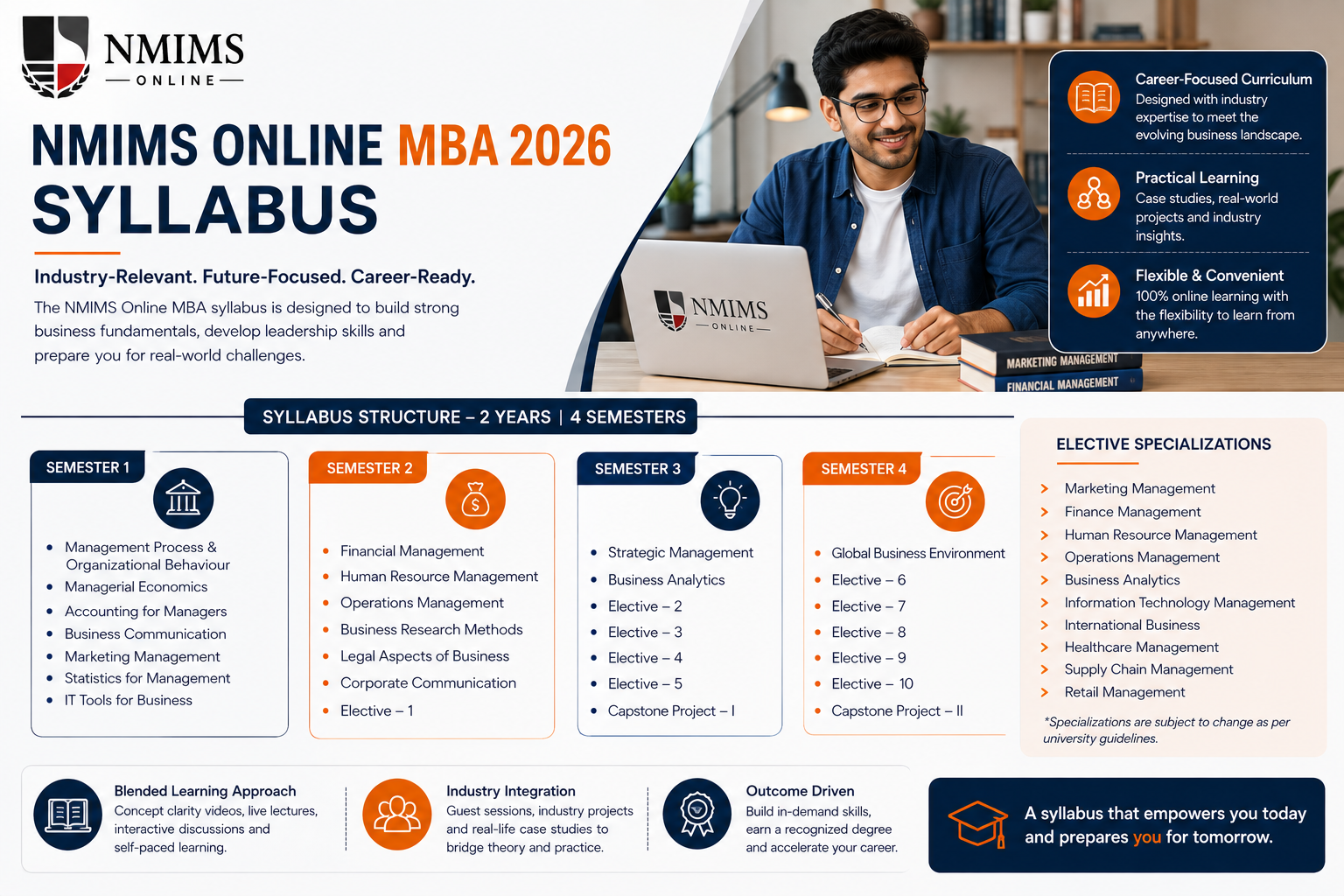
The current NMIMS Online MBA syllabus begins with general management subjects in the first two semesters. Semesters three and four add research, corporate subjects, seven specialization electives and a final project. The programme pages currently show a 102-credit structure completed across two years and four semesters.
This guide explains what each stage is designed to build, how the subjects connect and what to verify before choosing a specialization.
NMIMS Online MBA Curriculum at a Glance
| Semester | Main academic purpose | Published credit total |
|---|---|---|
| Semester 1 | Build a common foundation in business, people, markets and numbers | 24 |
| Semester 2 | Connect management functions and business decision-making | 24 |
| Semester 3 | Add finance, research and four specialization electives | 24 |
| Semester 4 | Add enterprise context, three electives and the final project | 30 |
| Total | Four-semester MBA structure | 102 |
How the NMIMS Online MBA Syllabus Is Structured
The curriculum follows a sensible progression.
- Learn the language of management. You begin with accounting, economics, communication, marketing, organisational behaviour and quantitative methods.
- Connect the functions. The second semester adds strategy, operations, HR, legal context, business analytics and management accounting.
- Choose an area of depth. The third semester introduces four electives alongside Corporate Finance and Research Methodology.
- Apply and integrate. The final semester combines international, ethical and sustainability perspectives with three more electives and a project.
Start Your Journey
Want Help Choosing the Right Specialisation?
Talk to our admissions team about the syllabus, electives, and how each specialisation connects to your career plans.
NMIMS Online MBA Semester 1 Subjects
| Subject | Credits | What it helps you understand |
|---|---|---|
| Business Communication | 4 | Clear written, spoken and stakeholder communication |
| Financial Accounting | 4 | How transactions appear in financial statements |
| Marketing Management | 4 | How organisations understand and serve markets |
| Micro Economics and Macro Economics | 4 | Firm-level choices and the wider economic environment |
| Organisational Behaviour | 4 | How individuals, teams and organisations behave |
| Quantitative Methods – I | 4 | Structured numerical reasoning for business decisions |
NMIMS Online MBA Semester 2 Subjects
| Subject | Credits | Main decision area |
|---|---|---|
| Business Analytics | 4 | Using data to support management decisions |
| Cost and Management Accounting | 4 | Understanding cost and internal performance |
| Legal Aspect of Business | 4 | Recognising the legal context of business actions |
| Strategic Management | 4 | Choosing direction and aligning execution |
| Human Resource Management | 4 | Managing talent and organisational capability |
| Operations Management | 4 | Designing and improving delivery processes |
NMIMS Online MBA Semester 3 Subjects
| Subject group | Credits |
|---|---|
| Corporate Finance | 4 |
| Research Methodology | 4 |
| Elective 1 | 4 |
| Elective 2 | 4 |
| Elective 3 | 4 |
| Elective 4 | 4 |
| Semester total | 24 |
NMIMS Online MBA Semester 4 Subjects
| Subject group | Credits |
|---|---|
| Corporate Sustainability | 4 |
| Indian Ethos and Ethics | 4 |
| International Business | 4 |
| Project | 6 |
| Elective 5 | 4 |
| Elective 6 | 4 |
| Elective 7 | 4 |
| Semester total | 30 |
The MBA project
The project carries six credits on the current programme pages. Examination information also describes a project report requirement for MBA Online learners.
A strong project should:
- Begin with a focused management question
- Use accessible and ethical evidence
- Explain the chosen method
- Separate findings from assumptions
- Connect analysis to a practical recommendation
- Acknowledge every external source
- Protect confidential organisational information
A smaller, well-supported project is generally stronger than an ambitious topic with weak evidence.
How Specialization Learning Fits into the Syllabus
NMIMS currently lists seven specializations:
- Business Management
- Marketing Management
- Finance Management
- Human Resources Management
- Operations and Data Sciences
- Information Technology Management
- Business Analytics
Business Management
The specialization should deepen cross-functional business judgement, strategy and execution. It may suit learners who need breadth across several functions.
Marketing Management
The focus is expected to move toward customers, markets, campaigns, channels and growth decisions. It may suit market-facing and entrepreneurial goals.
Finance Management
This direction deepens financial analysis, capital, risk and performance decisions. It may suit learners comfortable with numerical reasoning.
Human Resources Management
The specialization concentrates on talent, performance, employee relations and organisational capability.
Operations and Data Sciences
This option connects processes, supply, capacity and quality with data-informed improvement.
Information Technology Management
The focus is management of technology value, delivery, risk and transformation. It is not a replacement for deep engineering training.
Business Analytics
This direction uses data, visualisation and analytical methods to support decisions. The current Business Analytics page lists electives such as Data Analytics for Business, Machine Learning for Managers, Visual Analytics, Operational and Supply Chain Analytics and Consumer Data Analytics.
Because the live pages may contain repeated elective content, verify every exact list in the active brochure.
How Is the Syllabus Assessed?
The programme hub describes evaluation as IA + TEE:
- Internal Assessment can include academic work completed during the term.
- Term-End Examination evaluates learning at the end of the relevant cycle.
- Project work forms a separate applied component later in the programme.
CDOE describes examination assignments as case-based and application-oriented, and examinations as containing objective and application-oriented components. The current examination pattern, weightage, delivery method and calendar should always be confirmed through the Student Portal.
How to Study the Syllabus Effectively
Build connections between subjects
Do not study each paper in isolation. Use one business case across functions. For example, a decision to open a new distribution centre could involve demand, cost, financing, workforce, process and risk.
Create one evidence item per subject
Examples include:
- A short financial-statement interpretation
- A customer-segmentation memo
- A process map
- A workforce capability plan
- A dashboard critique
- A project business case
Start quantitative practice early
Accounting, finance, analytics and quantitative methods become harder when preparation is delayed. Short weekly practice is more reliable than last-minute review.
Protect project time
Research work includes topic approval, evidence collection, analysis, writing and revision. Add project milestones to the calendar before the final semester becomes busy.
Questions to Ask About the Curriculum
- Which exact electives apply to my specialization?
- Are all seven electives compulsory?
- Can electives change between batches?
- What is the current project format and approval process?
- What assessment weight applies to IA and TEE?
- Which activities require scheduled attendance?
- Are recordings available for every live session?
- Which tools are required for analytics or technology subjects?
- Can I use a workplace problem in the project?
- How are reappearance and project attempts handled?
Conclusion
The NMIMS Online MBA syllabus builds from functional foundations to integrated management, specialization and applied research. Its 102-credit structure is not valuable merely because it contains many subjects. The real value comes from connecting them, practising consistently and using the project to demonstrate sound business thinking. Confirm the current electives before selecting a specialization, especially where the live pages show repeated lists.
Frequently Asked Questions
The current programme has four semesters completed over a standard two-year duration.