Table of Content
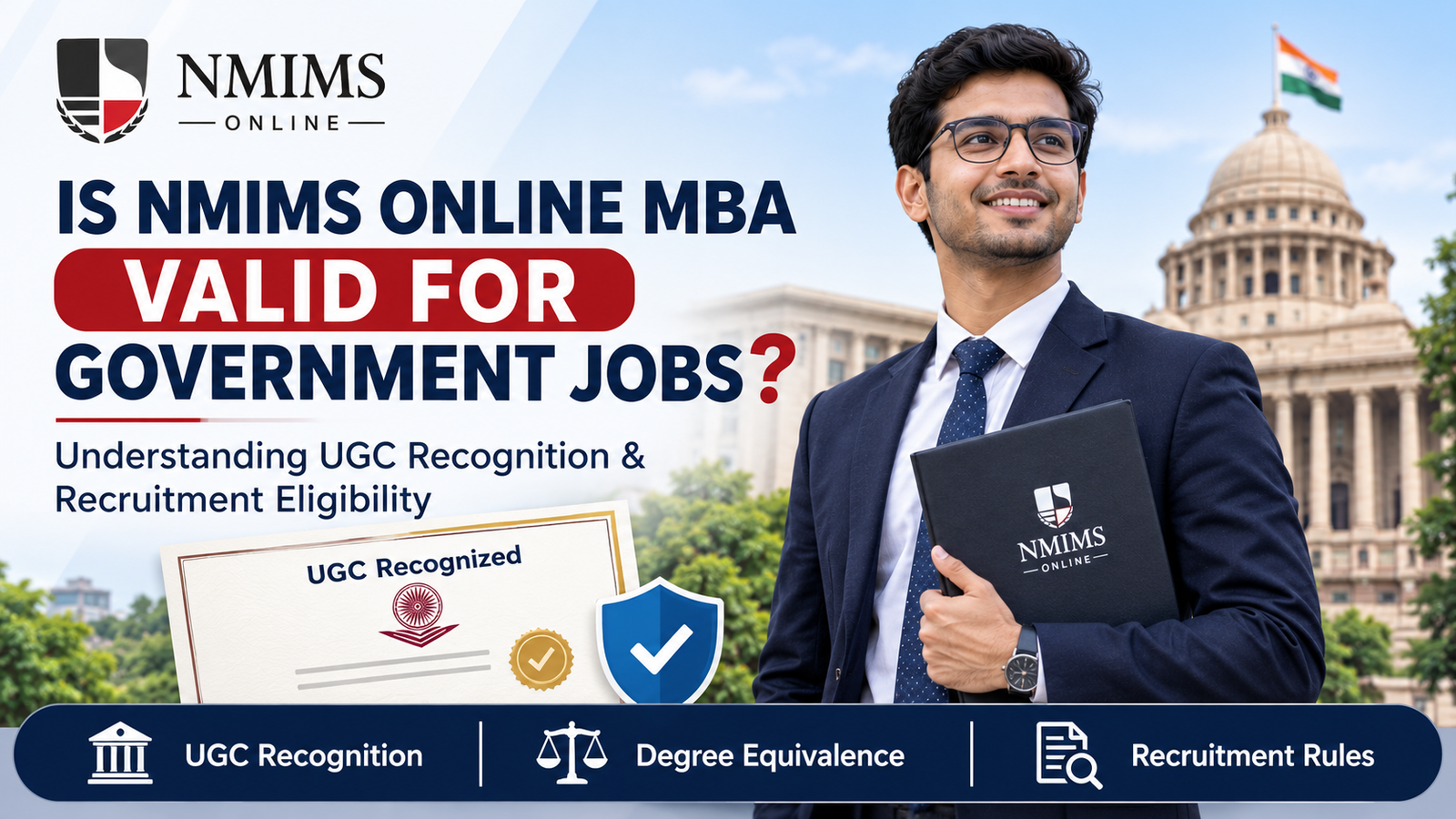
An NMIMS Online MBA may be used for a government-job application when the degree was earned through an officially recognised Online programme for the learner’s admission session and the recruitment notice accepts an MBA, postgraduate degree or equivalent qualification. Recognition alone is not a job guarantee: the recruiting authority decides discipline, marks, experience, mode and documentary requirements for each post.
Quick Answer: What Must Be True?
| Check | What the applicant needs to establish | Why it matters |
|---|---|---|
| University and programme | NMIMS, Master of Business Administration, PG level | A generic reference to “management education” is not enough |
| Delivery mode | Online mode, not a differently named campus, ODL, executive or diploma programme | The mode and award on the record must match the degree |
| Admission session | The exact academic year and intake should appear in the applicable UGC-DEB record | Recognition for one session does not automatically prove every later session |
| Recruitment wording | The post accepts MBA, a postgraduate degree, management qualification or a stated equivalent | The employer defines the essential qualification |
| Discipline or specialisation | The MBA specialisation fits any finance, HR, marketing, operations or other subject requirement | Some posts accept any MBA; others name a narrow discipline |
| Other eligibility | Marks, age, experience, category, cut-off date and documents are satisfied | A valid degree cannot cure another eligibility gap |
Start Your Journey
Need Help Picking the Right Fee Route?
Talk to our admissions team about tuition options, complete cost and how each route affects your cash flow.
What UGC Equivalence Actually Means
The UGC public learner notice states that undergraduate and postgraduate degrees awarded through ODL or Online mode by Higher Educational Institutions recognised under the applicable regulations, and conforming to the UGC specification of degrees, are treated as equivalent to the corresponding awards offered through conventional mode.
This is important because it addresses the status of the delivery mode. It means a properly recognised Online degree should not be treated as a lesser academic award merely because teaching took place online.
However, equivalence of mode does not erase the wording of a recruitment rule. The UGC FAQ explains that equivalence for employment purposes is decided by the employing organisation. A recruiting body may lawfully define an essential qualification more narrowly, for example by requiring:
- An MBA in Finance rather than any MBA.
- A master’s degree with at least 55% marks.
- Two years of post-qualification experience.
- A degree obtained before the application’s closing date.
- A qualification from a recognised university plus a specific professional certification.
- An equivalence certificate where the degree title differs from the notification.
How to Verify the NMIMS Online MBA Before Applying
Do not begin with an advertisement, counsellor message or third-party comparison page.
1. Match the exact UGC-DEB entry
Use the UGC-DEB recognised-programme search and select the academic year and session that correspond to the learner’s admission. Match all of these fields:
- Narsee Monjee Institute of Management Studies.
- Master of Business Administration.
- Postgraduate level.
- Online mode.
- Academic year and admission session.
2. Check the UGC notice board
Read debarment, no-admission and public precaution notices. An official UGC notice dated 17 April 2023 covered three specified NMIMS admission sessions: January-February 2023, July-August 2023 and January-February 2024. Later sessions must be judged using later official records rather than assumptions in either direction.
3. Confirm the admission trail
Keep the offer letter, fee receipt, enrolment number, grade cards, degree certificate and the UGC-DEB record saved on the date of verification. The programme name and mode should be consistent across the documents.
4. Preserve DEB-ID and ABC details
UGC requires a DEB-ID for learners enrolling in ODL/Online programmes. The DEB-ID is created through the official portal using an Academic Bank of Credits ID. It is an important part of the official enrolment trail, although it does not replace the programme-session check.
Read the Recruitment Notification Like an Eligibility Officer
Government-job advertisements use different formulations. Small differences can change the answer.
| Common wording in a notification | What it usually requires you to check | Risk if misread |
|---|---|---|
| “MBA from a recognised university” | Degree title, awarding university, recognition and cut-off date | Assuming every management diploma is an MBA |
| “MBA/PGDM in Finance” | Accepted award plus named specialisation; PGDM equivalence may need separate proof | Applying with a different specialisation |
| “Postgraduate degree in any discipline” | Whether an MBA counts as the stated postgraduate degree and meets marks rules | Ignoring a minimum-percentage condition |
| “MBA or equivalent” | Who is authorised to decide equivalence and which certificate is required | Self-declaring equivalence without evidence |
| “Full-time MBA” | Whether the notification expressly restricts mode | Treating UGC mode equivalence as permission to ignore explicit wording |
| “Two years’ experience after MBA” | Date of final result and whether experience is post-qualification | Counting earlier experience that the rule excludes |
A Step-by-Step Government Job Verification Workflow
Step 1: Identify the exact post
Record the organisation, advertisement number, post name, grade, closing date and essential-qualification clause. Do not work from a social-media summary.
Step 2: Separate essential and desirable qualifications
An essential qualification determines eligibility. A desirable qualification may affect shortlisting but is not always mandatory. Read the definitions and footnotes as carefully as the main table.
Step 3: Map every phrase to evidence
Create a one-page mapping: “MBA” to degree certificate, “recognised university” to institutional and programme-session evidence, “Finance” to specialisation transcript, “50%” to consolidated marksheet, and “experience” to dated employer certificates.
Step 4: Check the cut-off rule
Many recruitments require the qualification to be completed by the closing date. Being enrolled, waiting for a final result or holding a provisional result after the cut-off may not qualify.
Step 5: Ask a narrow written question
If the wording is ambiguous, do not ask, “Is an online MBA valid?” Ask: “For Advertisement X, Post Y, does an MBA awarded by NMIMS through a UGC-recognised Online programme for the stated session satisfy Clause Z, which requires [quote or paraphrase the clause]?”
Step 6: Apply only with supportable declarations
Online application forms often require a declaration that information is correct. Use the exact mode, university and award stated on official documents. Do not select “regular” merely because the form lacks a clear Online option; seek instructions.
Step 7: Prepare for document verification
Carry originals and the document set listed in the notice. A portal accepting an application does not prove final eligibility. Recruiting bodies frequently verify qualifications later.
Central Government, State Government, PSU and Bank Jobs
The same verification principle applies across public-sector recruitment, but the rule owner differs.
| Recruitment context | Who sets the operative rule? | Extra issue to inspect |
|---|---|---|
| Central ministry or department | The named recruiting authority under the notified rules | Degree wording, experience and central cut-off conditions |
| State department or commission | State recruitment rules and the commission/department | State-specific equivalence or language requirements |
| Public-sector undertaking | The PSU’s advertisement and service rules | Specialisation, full-time wording, percentage and experience |
| Public-sector bank or financial institution | The bank/institute and its recruitment notice | Finance/HR specialisation, professional certification or experience |
| University or academic administration | The university plus applicable UGC/statutory rules | Subject relevance and separate teaching/research qualifications |
Documents to Keep Ready
Prepare a clean, auditable file rather than collecting evidence after a query is raised.
- Recruitment advertisement, annexures, FAQ and corrigenda.
- Submitted application and fee receipt.
- NMIMS admission letter and enrolment details.
- Semester grade cards and consolidated transcript.
- Provisional certificate and final MBA degree, as applicable.
- UGC-DEB programme-session record saved with access date.
- Applicable UGC public notices and equivalence notice.
- DEB-ID and ABC-related acknowledgement where applicable.
- Category, disability, domicile or age-relaxation certificates in the prescribed format.
- Experience certificates showing role, dates, full-time status and duties.
- Written clarification from the recruiting authority, if obtained.
Situations Where You Should Not Rely on a Generic “Valid” Claim
Pause and obtain clarification when:
- The notification says “full-time,” “regular” or “campus” MBA.
- The post requires a specialisation not printed on the degree or transcript.
- Your admission session is not visible in the official UGC-DEB record you checked.
- The university name, programme title or mode differs across documents.
- The essential qualification is “MBA or equivalent” but the equivalence authority is not identified.
- Your final result falls after the eligibility cut-off.
- Required experience must be earned after the MBA.
- A third party promises government employment or guaranteed acceptance.
Does Online Mode Reduce Selection Chances?
For formal eligibility, use the recognition record and notification. For selection, the degree is only one part of the profile. Competitive examinations, domain knowledge, experience, interview performance, reservation rules and the number of vacancies may be more decisive.
Applicants can strengthen the practical value of an Online MBA by connecting coursework to the post. A finance applicant can show budgeting or analysis work; an HR applicant can document workforce processes; an operations applicant can show process improvement; and a project applicant can present measurable delivery outcomes. These examples help in interviews, but they do not replace the essential qualification.
Conclusion
An NMIMS Online MBA can be valid for government job applications if the university, program, and admission session meet the applicable UGC-DEB recognition requirements. However, eligibility depends on the recruitment notification issued by the concerned authority. Before applying for central or state government positions, PSU roles, or public-sector bank jobs, carefully verify the accepted degree, specialization, marks, experience, and mode requirements. Keep all academic and recognition documents ready, and seek written clarification whenever eligibility conditions are unclear.
Frequently Asked Questions
No degree is automatically eligible for every government job. A recognised NMIMS Online MBA may meet an MBA or postgraduate requirement, but the recruiting notification decides the accepted discipline, mode, marks, experience and other conditions.