Table of Content
NMIMS Online MBA can support promotion readiness by broadening management knowledge and helping a professional apply finance, marketing, people, operations, analytics and strategy concepts at work. It does not guarantee promotion. Advancement also depends on performance, wider responsibility, leadership evidence, role availability, internal policy, manager support and business need.
Can NMIMS Online MBA Help With a Promotion? Quick Answer
| Promotion condition | How the MBA may help | What the MBA cannot replace |
|---|---|---|
| Capability | Build broader management and functional knowledge | Required technical depth or years of experience |
| Performance | Improve how problems are analysed and decisions are explained | A record of missed targets or weak execution |
| Scope | Prepare the learner to understand work beyond the current task | Actual ownership of a team, budget, process or project |
| Visibility | Provide applied projects and clearer business communication | Relationships, trust and stakeholder exposure |
| Opportunity | Strengthen readiness when a role opens | Headcount, budget, timing or company structure |
| Selection | Support profile development and interview preparation | Employer judgement, competition or final approval |
What Employers Usually Promote
Promotion decisions differ, but many organisations look for evidence across five areas.
1. Consistent performance
The person delivers the current role reliably. Deadlines, quality, customer commitments and team responsibilities are under control. A qualification rarely compensates for weak day-to-day execution.
2. Next-level scope
The employee is already handling some work associated with the higher role. This may involve planning, coaching, stakeholder coordination, commercial decisions, risk ownership or cross-functional delivery.
3. Leadership behaviour
Leadership is not limited to direct reports. It includes making priorities clear, resolving conflict, communicating decisions, sharing credit, escalating responsibly and helping others succeed.
4. Business impact
The candidate can connect work to revenue, cost, quality, speed, risk, customer experience or employee outcomes. Activity without a result is weak promotion evidence.
5. Organisational opportunity
A person may be ready when no role is available. Headcount, structure, budget, succession and timing matter. The promotion plan should therefore include both capability-building and an honest view of opportunity.
Start Your Journey
Need Help Picking the Right Fee Route?
Talk to our admissions team about tuition options, complete cost and how each route affects your cash flow.
Connect the MBA to the Next Role
Start with the target role’s responsibilities. Then map the curriculum to the business problems that role owns.
| Next-level responsibility | Relevant management learning | Evidence to build at work |
|---|---|---|
| Budget or commercial ownership | Accounting, finance, economics and cost management | Budget analysis, variance explanation or business case |
| Customer or growth responsibility | Marketing, consumer behaviour and strategy | Funnel diagnosis, retention action or market recommendation |
| Team responsibility | Organisational behaviour, HR and communication | Coaching plan, workload improvement or conflict resolution |
| Process or service ownership | Operations, quantitative methods and analytics | Cycle-time, quality, capacity or cost improvement |
| Cross-functional project | Strategy, project thinking and stakeholder communication | Clear charter, governance rhythm, risk log and outcome |
| Technology-business coordination | IT management, business analytics and process modelling | Requirements, adoption or process-change case |
Choose a Specialisation Based on the Promotion Gap
The programme currently lists seven specialisations. The right option depends on the next role, not only the current department.
Business Management
Useful when the next role requires cross-functional thinking, planning, commercial awareness or broader unit responsibility. The candidate still needs evidence of execution and influence.
Marketing Management
Relevant for roles involving customers, campaigns, channels, brand, growth or market insight. Add current platform knowledge and measurable campaign evidence where required.
Financial Management
Useful for deeper budgeting, analysis, investment, risk or finance responsibility. It does not replace regulated qualifications or advanced modelling required by some roles.
Human Resource Management
Relevant for people operations, talent, L&D, performance and employee-experience responsibility. Senior roles need judgement, confidentiality and employment-practice exposure.
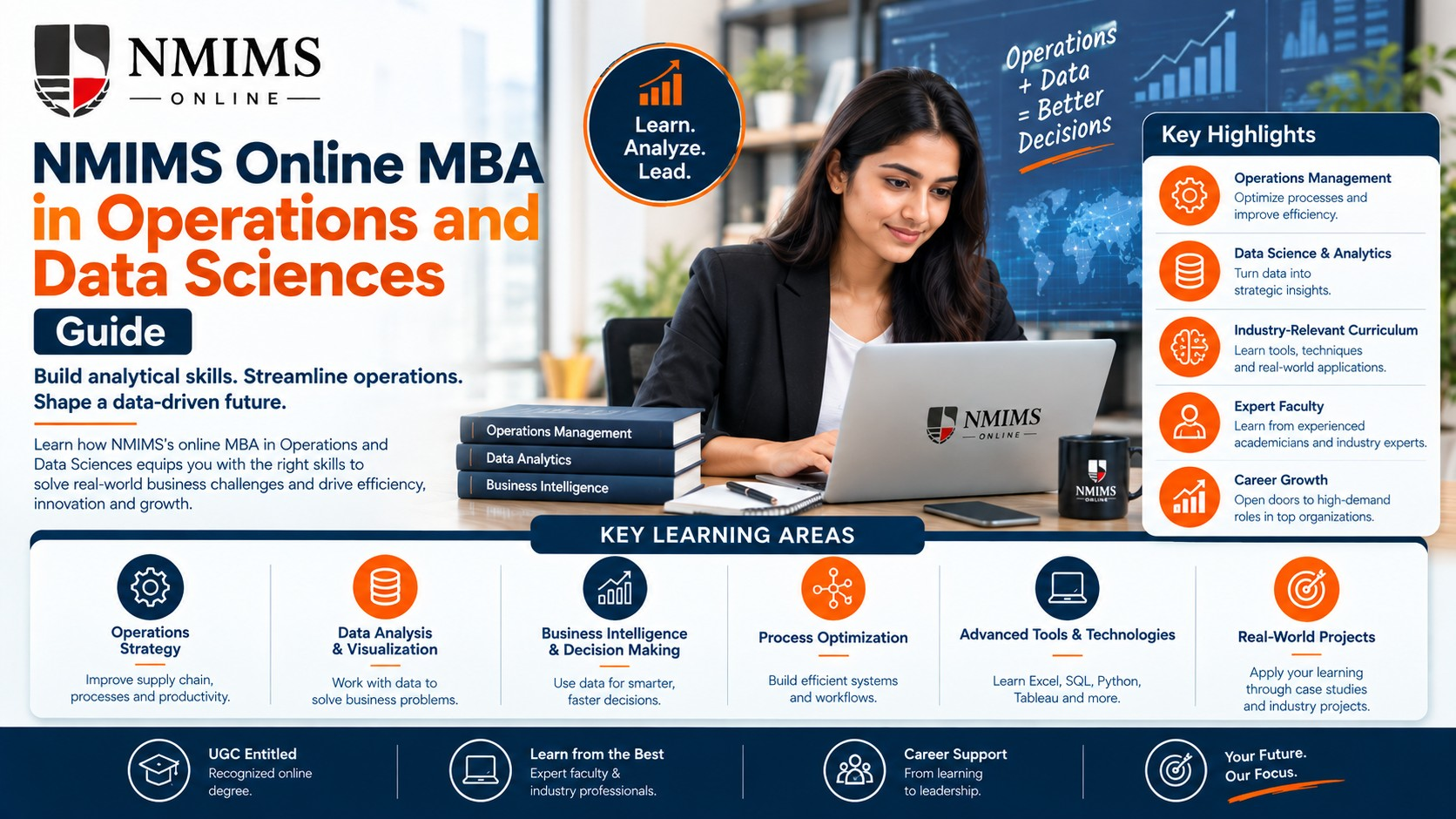
Operations and Data Sciences
Useful for process, capacity, supply chain, quality, service delivery and data-informed operations. Add domain systems, spreadsheets and process evidence.
Business Analytics
Relevant when the higher role requires metrics, visualisation, analysis and decision support. Management-oriented analytics should be combined with the practical tools repeated in target job descriptions.
Information Technology Management
Useful for professionals moving toward IT business analysis, project, service, product-operations or digital-initiative responsibility. Technical depth may still be required for specialist roles.
Build a Promotion Evidence Portfolio
A private evidence portfolio is not a design portfolio. It is a structured record of next-level work.
Keep a one-page achievement log
For each result, record:
- Business problem.
- Baseline or starting condition.
- Your responsibility.
- Action and trade-off.
- Stakeholders influenced.
- Result and measurement period.
- What you learned.
Collect evidence across four categories
- Execution: reliable delivery, quality and risk control.
- Improvement: measurable change to cost, speed, quality or experience.
- Leadership: coaching, influence, conflict handling or decision ownership.
- Breadth: work beyond the current job description or function.
Protect confidential information
Use the portfolio for reflection and promotion conversations. Do not take proprietary data outside the company or publish sensitive employee, customer or commercial details.
Apply One MBA Concept to Work Each Month
The degree becomes more useful when learning is converted into action.
| Month | Example application | Promotion signal |
|---|---|---|
| 1 | Build a simple budget-versus-actual explanation | Commercial understanding |
| 2 | Map a customer or stakeholder journey | Customer focus |
| 3 | Identify delay and rework in one process | Operational improvement |
| 4 | Create a decision dashboard with a clear question | Analytical judgement |
| 5 | Coach a colleague using an agreed development goal | People leadership |
| 6 | Present a cross-functional recommendation | Executive communication |
Have the Promotion Conversation Early
Waiting until graduation to mention career goals creates uncertainty. A useful manager conversation can cover:
- The next role or responsibility being targeted.
- The current strengths that already support it.
- Two or three gaps the manager sees.
- A stretch assignment that can build evidence.
- The outcomes that would demonstrate readiness.
- The likely decision cycle and available opportunities.
A 180-Day Promotion-Readiness Plan
| Period | Main action | Evidence produced |
|---|---|---|
| Days 1-15 | Obtain the next-role description and promotion criteria | Responsibility and competency map |
| Days 16-30 | Review strengths and gaps with the manager | Agreed development priorities |
| Days 31-60 | Take one stretch assignment with clear scope | Project charter and baseline |
| Days 61-90 | Apply relevant MBA learning to the assignment | Analysis and recommendation |
| Days 91-120 | Lead stakeholders through implementation | Influence and execution examples |
| Days 121-145 | Measure results and document limitations | Business-impact case |
| Days 146-165 | Practise the promotion interview or panel | Clear evidence stories |
| Days 166-180 | Review readiness, opportunity and next decision | Promotion case or revised plan |
Use NMIMS Career Services for Promotion Preparation
NMIMS currently describes practice interviews for jobs, career growth, promotions and domain changes. The broader Career Services offer also includes coaching and profile development.
Use practice interviews to improve:
- Examples of leadership without authority.
- A failure or recovery story.
- A decision made with incomplete information.
- A business result with the candidate’s contribution separated from the team’s.
- A conflict handled without blaming others.
- A plan for the first 90 days in the higher role.
Career coaching can help clarify direction, but internal promotion criteria must come from the employer. A coach cannot promise headcount or approval.
Prepare Eight Promotion Stories
Build concise examples for:
- Delivering an important result.
- Improving a process.
- Influencing a difficult stakeholder.
- Coaching or enabling another person.
- Managing competing priorities.
- Correcting a mistake.
- Using data to change a decision.
- Taking responsibility beyond the current role.
When the MBA May Have Limited Promotion Impact
The next role requires a different licence or technical qualification
An MBA will not substitute for a professional credential, specialist degree or regulatory requirement.
Current performance is not reliable
The first priority should be closing execution gaps. Additional study can add pressure if workload is already affecting results.
The organisation has no higher role
A small or flat team may have limited promotion paths. Broader scope, lateral progression or an external move may be more realistic.
The learner cannot show applied value
Grades alone may not demonstrate readiness for people, budget or business responsibility.
The person expects the title before the work
Many employers look for evidence of next-level behaviour before formal promotion. Seek appropriate stretch responsibility without permanently accepting uncompensated role expansion.
Promotion vs External Job Change
| Decision area | Internal promotion | External move |
|---|---|---|
| Evidence base | Existing performance and reputation | CV, interview, references and selected proof |
| Role knowledge | Better visibility into actual work | Must infer from vacancy and interview |
| Salary process | Internal band and policy may constrain increment | Market pricing may differ but competition is wider |
| Main advantage | Trusted context and relationships | More roles and possible change in scope |
| Main risk | No vacancy or delayed decision | New-company uncertainty and probation |
A Promotion Decision Scorecard
Score each statement 0 for no, 1 for partly and 2 for yes.
- I know the exact next role and its responsibilities.
- My current performance is consistently strong.
- My manager has explained the readiness criteria.
- I have handled at least one next-level assignment.
- I can show business impact, not only activity.
- I have examples of leadership and stakeholder influence.
- My specialisation supports a documented capability gap.
- I understand the likely role-availability timeline.
- I can discuss salary without assuming an MBA premium.
- I have an alternative plan if the role does not open.
| Score | Interpretation |
|---|---|
| 16-20 | Stronger promotion case; confirm timing and decision process |
| 11-15 | Progressing, but build the missing evidence or opportunity clarity |
| 0-10 | The case currently depends too much on completing the degree |
Conclusion
The NMIMS Online MBA can strengthen your promotion prospects by developing management knowledge, leadership skills, and broader business understanding. However, earning the degree alone does not guarantee career advancement. Professionals must apply their learning at work, take on additional responsibilities, demonstrate measurable business impact, and build strong leadership evidence. By aligning their specialization with future role requirements and discussing growth opportunities with managers, learners can use the program as a practical step toward greater responsibilities and long-term career growth.
Frequently Asked Questions
No. It may build useful knowledge and support preparation, but promotion depends on performance, next-level evidence, role availability, employer policy and the selection decision.