Table of Content
Introduction
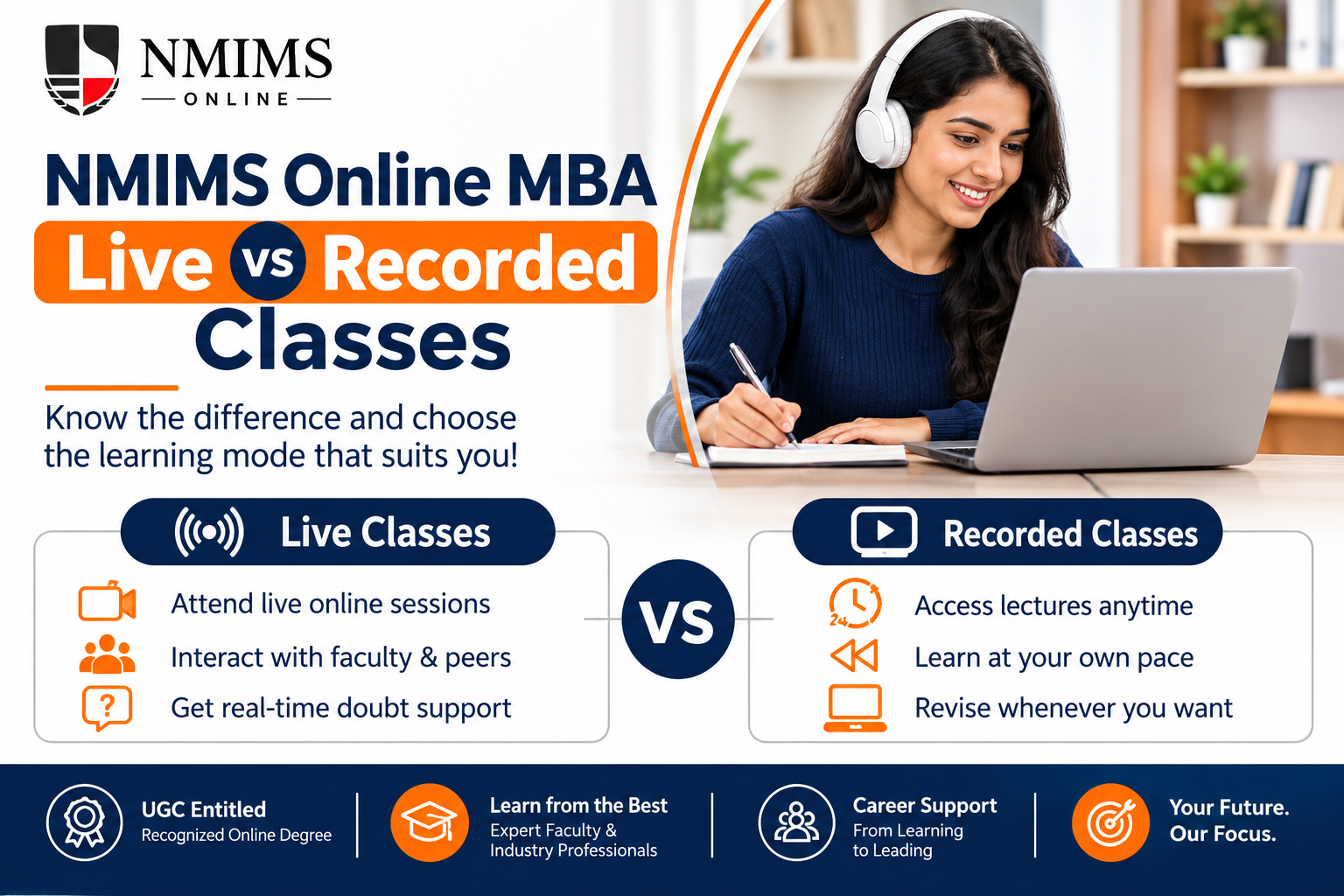
NMIMS Online MBA uses both live online learning and recorded lectures. Learners receive live and recorded access, while recordings are available 24X7 through the learning platform. Live sessions are useful for interaction and doubt clearing; recordings support revision and genuine schedule conflicts. The current timetable, attendance rule and recording coverage must still be checked for the active semester.
NMIMS Online MBA Live Classes: Quick Answer
| Question | Current verified or safe answer |
|---|---|
| Are classes available live? | Yes. NMIMS live online or live interactive lectures. |
| Are recorded lectures available? | Yes. 24X7 access to recorded lectures. |
| Can a learner study only through recordings? | Do not assume this. Check attendance, participation and assessment rules for every subject. |
| Where are classes and resources accessed? | Through the Student Zone or Student Portal and the university's stated mobile access. |
| What other learning resources are listed? | E-books, journals, lecture transcripts, courseware and faculty interaction. |
| Are all live events necessarily recorded? | The public page does not promise that every event, doubt session or expert interaction is recorded. |
| Are class timings fixed for the full programme? | Public pages do not publish one permanent timetable. Use the current academic schedule. |
What NMIMS Officially Confirms About the Learning Format
The NMIMS CDOE MBA is a two-year programme across four semesters, with four years of validity. Evaluation is presented as Internal Assessment plus Term-End Examination, or IA + TEE.
For delivery, the university publishes the following features:
- Access to live and recorded lectures.
- 24X7 access to recorded lectures.
- Student Zone access through the portal and mobile app.
- Courseware and other learning-related information in the platform.
- E-books, journals and lecture transcripts.
- Faculty interaction for resolving queries.
- Student support through a ticketing tool, callback scheduling and chat during published support hours.
Live Classes vs Recorded Lectures: Main Differences
| Learning need | Live class | Recorded lecture |
|---|---|---|
| Faculty interaction | Questions may be raised during the scheduled session, subject to the session format. | Questions must usually be noted and taken to the available support or faculty channel. |
| Learning rhythm | Creates a fixed appointment and reduces postponement. | Gives control over timing but requires self-discipline. |
| Difficult concepts | Allows immediate clarification when interaction is enabled. | Allows pausing, replaying and taking detailed notes. |
| Work conflict | Less flexible because the session follows a timetable. | Useful for recovering from a genuine clash. |
| Revision | Helpful for hearing the complete explanation once. | Better for repeating selected segments before assessment. |
| Peer exposure | May include questions or perspectives from other learners. | Usually a one-way review of the recorded session. |
| Availability | Depends on the published schedule. | NMIMS publicly states 24X7 recorded access, subject to current portal rules. |
What Live Classes Are Best Used For
Clarifying a Difficult Point
Quantitative Methods, accounting, finance and analytics topics often contain steps that build on one another. A small misunderstanding early in a calculation can affect the full answer. Live interaction is valuable when the learner arrives with a specific question instead of saying only, "I did not understand the chapter."
Testing Whether a Concept Can Be Applied
Management education is not limited to definitions. A live discussion can help a learner compare two approaches, defend a recommendation or see why the same framework produces different decisions in different situations.
Hearing Questions the Learner Did Not Think Of
Another participant may notice a legal, financial, people or execution issue that the learner missed. This is one reason live sessions can add value beyond watching the same explanation alone.
Creating a Weekly Deadline
A scheduled class gives the week an anchor. Reading can be completed before the session, unanswered questions can be taken into it, and a short review can be done afterwards. This limits the common online-learning problem of carrying unwatched content from one week to the next.
What Recorded Lectures Are Best Used For
Recovering from a Real Schedule Conflict
A client call, shift change, family responsibility or travel day can clash with a live session. A recording helps only when the missed class is placed into the calendar soon afterwards. "I will watch it later" is not a recovery plan.
Replaying a Complex Explanation
Recordings are particularly useful for formulas, financial statements, models, process diagrams and multi-step examples. Pause after each step, reproduce it without looking, and then continue.
Building Revision Notes
The first viewing should capture the structure of the topic. A second, selective viewing can extract key distinctions, common mistakes, calculations and examples. Rewatching the entire session is often less efficient than returning to exact segments.
Adjusting Pace Without Lowering Attention
Familiar introductory material may be reviewed faster, while difficult material may need a slower pace. Playback control should reduce wasted time, not encourage superficial completion.
Are Live Classes Compulsory in NMIMS Online MBA?
The public MBA hub confirms live and recorded access but does not place a universal attendance percentage beside the learning-experience section. Therefore, an independent website should not claim that all live sessions are compulsory or that none of them are compulsory.
Before each term, verify:
- Whether attendance is recorded for the subject.
- Whether participation contributes to Internal Assessment.
- Whether a particular workshop, orientation, expert session or doubt-clearing event has a separate rule.
- Whether the recording will be uploaded and for how long it will remain accessible.
- Whether missed live activity can be replaced by another academic task.
- Which timetable and time zone apply.
A Practical Weekly Learning Workflow
Before the Live Session: 30 to 45 Minutes
- Read the module outline or assigned pages.
- Write the main concept in one sentence.
- Mark terms, calculations or examples that are unclear.
- Prepare two precise questions.
During the Live Session
- Take notes around decisions and reasoning, not every spoken sentence.
- Mark the time or topic where a concept became unclear.
- Write one workplace or business example beside each major idea.
- Record any instruction about assessment, reading or the next session.
Within 24 Hours
- Close the notes and explain the topic from memory.
- Check the explanation against the course material.
- Convert one concept into a short answer, calculation or case response.
- Add unresolved questions to the support or faculty channel specified for the subject.
At the End of the Week
- Review all six subjects briefly rather than revising only the easiest one.
- Check deadlines, notices and the next timetable.
- Schedule any recording that still needs to be watched.
This process turns a lecture into retrieval and application. Watching alone can create familiarity without the ability to answer a question independently.
If You Miss a Live Class: 48-Hour Recovery Plan
| Time | Action | Output |
|---|---|---|
| First 12 hours | Confirm whether the recording is available and note related instructions. | Recording link and deadline captured. |
| Within 24 hours | Watch the recording without multitasking. | Structured notes and marked questions. |
| Within 36 hours | Use the courseware or reading to close gaps. | Corrected notes and one-page summary. |
| Within 48 hours | Practise one question or application. | Evidence that the topic can be used. |
| Next available interaction | Ask only the questions that remain unresolved. | Specific clarification, not a general request. |
How the Best Method Changes by Subject
Numerical Subjects
For accounting, finance, quantitative methods and analytics, use the live class to understand the method and the recording to repeat the steps. The final test is whether the problem can be solved without the video.
Concept-Heavy Subjects
For organisational behaviour, human resources, ethics and strategy, concentrate on distinctions, frameworks and application. After the lecture, compare two concepts in a table or apply one to a short case.
Law and Policy-Related Subjects
Separate the rule from its business implication. Do not depend on a simplified lecture note when the course material requires a more exact definition or process.
Specialisation Electives
Connect every topic to the target role or current job. A marketing learner might audit a campaign decision, while an operations learner maps a bottleneck. This makes the chosen specialisation more useful than passive coverage of elective names.
Research Methodology and the Project
Use live interaction to test whether the research question is specific and feasible. Use recordings and written resources for repeatable reference while developing the problem, method, analysis and recommendations.
Frequently Asked Questions
Yes. NMIMS offers online or live interactive lectures as part of the learning experience. The exact timetable and participation rule should be checked for the active semester.